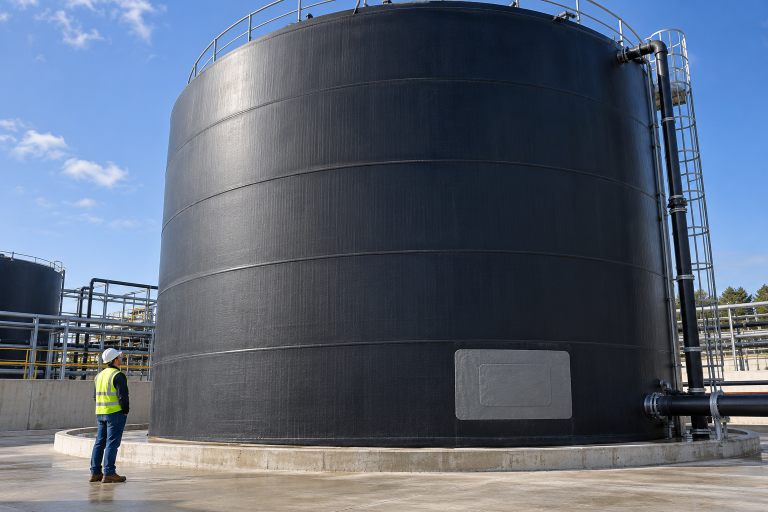
Repairing a large plastic tank presents most of the same challenges that a damaged gas tank does, low energy surfaces, movement of the tank wall, stress concentration, moisture, etc. Those issues are multiplied by the size of the tank. Things become more challenging if the damage is near the bottom of the large volume tank. The Tech Patch Repair System (TPRS™) has demonstrated that those problems largely disappear with Tech-Bond and TPRS™. As I’ve said, a poly-to-poly bond is one of the best bonds that can be achieved. Plus, for whatever reasons, those repair large volume tanks have not experienced the same difficulties that those repairing gas tanks that faced. As stated, gasoline, any fuel, is difficult to contain.
I’m going to present this subject via a series of case studies. As stated, TPRS™ has repaired a number of large poly tanks, 3, 5, 8 and 10,000 gallons in size. For our customers who have this issues, there really has not been a problem in making the repair. If you follow our motto of Precision when applying the Patch, you will get the promised Performance and Permanence.
A Repaired Large Poly (Plastic) Tank
Is 1800 psi Sufficient?
There are repair systems that have a product that can be used to repair plastic gas tanks. From our experience and feedback from customers that suggest that the success percentage for repairing damaged gas tanks is not terribly high. There are far fewer options for repair large volume plastic tanks In addition, the pressure is minimal as opposed to the pressure found in pipe. The formula for determing the pressure at the bottom of the tanks is below.
Hydrostatic-pressure formula
\[ P=\rho gh \]
Where:
- \(P\) = pressure
- \(\rho\) = liquid density
- \(g\) = gravitational acceleration
- \(h\) = liquid depth above the point being evaluated
For water in U.S. units, the convenient formula is:
\[ \boxed{P\text{ (psi)}=0.433 \times h\text{ (feet)}} \]
Examples:
| Water depth | Pressure at bottom |
|---|---|
| 5 ft | 2.17 psi |
| 10 ft | 4.33 psi |
| 15 ft | 6.50 psi |
| 20 ft | 8.66 psi |
| 25 ft | 10.83 psi |
| 30 ft | 12.99 psi |
For liquids other than water:
\[ \boxed{P\text{ (psi)}=0.433 \times h\text{ (ft)} \times SG} \]
Here, SG is the liquid’s specific gravity. A liquid with an SG of 1.5 produces 50% more pressure than water at the same depth.
This pressure acts in every direction at that depth. Therefore, a repair near the bottom of a large tank generally faces greater liquid pressure than an identical repair near the top. However, repair design must also consider tank-wall flexing, crack geometry, stress around fittings, temperature cycling and the total area over which the pressure acts.
So Pressure is not the Issues when Repairing a Large Volume Plastic (Poly) Tank
In a large atmospheric poly tank, total capacity does not determine pressure at the repair—the liquid’s vertical depth does. Water produces only approximately 0.433 psi for every foot of depth, so even a 20-foot column generates about 8.7 psi at the bottom. The greater challenges are the total force acting across the damaged area, movement and flexing of the tank wall, crack propagation, surface condition, contamination and the difficulty of reliably bonding low-surface-energy polyethylene. Consequently, a properly sized Tech Patch that bonds through the interface and distributes the load beyond the damaged area can manage the relatively modest hydrostatic pressure while accommodating the tank’s normal movement.
What if my large volume tank contains chemicals or other materials or liquids?
Tank Contents Determine the Repair Design
If your tank contains anything other than water, contact Tech-Bond before selecting or installing the repair. The liquid’s specific gravity, temperature, chemical composition and potential interaction with the tank, Bonding Agent and patch materials must all be evaluated. Tech-Bond uses this information—together with the tank material, damage, location and operating conditions—to determine the appropriate patch size, number of layers, Bonding Agent and protective structure. We call this application-specific design process Intelligent Interface Engineering (IIE™): engineering every interface so the completed repair is compatible with both the tank and its contents.