
A Personal Note from Don Meyers
Over the years, more than 99% of the fuel tanks repaired using the Tech-Bond repair method have been successfully repaired. In a small number of cases, achieving a successful repair required a second application.
We understand that every damaged tank is different. The size and location of the damage, the condition of the surrounding material, previous repair attempts and surface preparation can all affect the repair.
That’s why we stand behind the repair process. If your fuel-tank repair requires a second application, Tech-Bond will provide you with a replacement Tech Patch at no charge.
Our objective isn’t simply to sell you a patch. Our objective is to help you successfully repair the tank.
— Don Meyers
Founder & CEO, Tech-Bond Global
Large Metal Fuel Tank Repair — Repairing Severe Corrosion and Multiple Holes
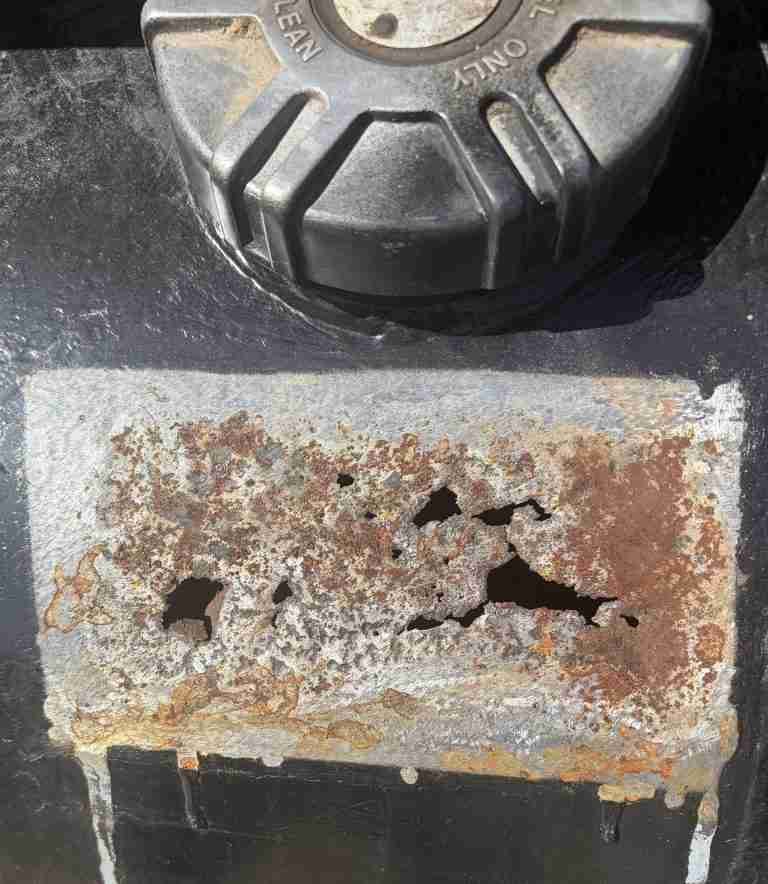
This large metal fuel tank repair presented a challenge far beyond sealing a simple crack or pinhole. Years of corrosion had severely deteriorated the metal surrounding the damaged area, leaving multiple holes and sections where much of the original metal was simply gone. A conventional spot repair would not be enough. The challenge was to restore the damaged area by creating a new, reinforced surface across and beyond the weakened metal—demonstrating how the Tech-Bond approach can make repair rather than replacement possible even when the original substrate has suffered extensive deterioration.
Surface Preparation Reveals the Extent of the Damage
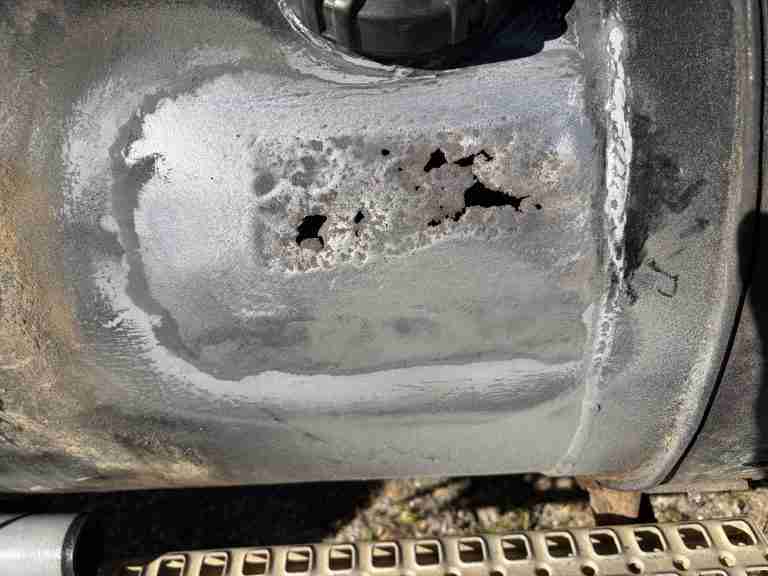
After the damaged area was thoroughly sanded, the true extent of the corrosion became clear. Multiple holes had developed through the tank wall, with significant thinning and deterioration of the surrounding metal. This is why proper surface preparation is so important: it not only removes rust, coatings and contamination from the repair area, it exposes the actual condition of the substrate. With the damaged metal fully exposed, the repair could be designed to extend well beyond the weakened area and bond to sound metal surrounding it.
Sanding was done with a rotary sander and finished with hand sanding. With a metal fuel tank, applying the catalyst, our Activator/Accelerator is the final step. NOTE: Do not let the SI Black Bonding Agent come in contact with even with the fumes of the catalyst, early polymerization will occur.
Rebuilding the Damaged Area — The First Reinforcement Layer

With the tank surface prepared and the full extent of the corrosion exposed, the next step was to rebuild the damaged area rather than simply attempt to fill the individual holes.
The first reinforcement patch was bonded across the entire deteriorated section, extending beyond the perforated and weakened metal onto the prepared surrounding surface. This creates a continuous reinforced area over the original damage and distributes stresses across a much larger portion of the tank.
Because this is a fuel tank, the repair does not stop with this first patch. Tech-Bond uses a patch-on-a-patch approach for fuel-tank repairs, adding a second bonded reinforcement layer over the first. The objective is to create a redundant, reinforced repair system rather than relying on a single layer over severely damaged metal.
The photographs show an important difference between this approach and simply plugging holes: the repair addresses the entire damaged area, not just the places where fuel can currently escape.
Reinforcing the Repair | the Patch-on-a-Patch Technique

Because this repair involves a fuel tank, Tech-Bond uses a patch-on-a-patch repair. After the first patch has bridged the holes and reinforced the deteriorated metal, a second, larger patch is bonded over the first repair and onto the surrounding prepared tank surface. This creates another continuous bonded interface and extends the reinforced area beyond the original damage. Rather than depending upon a single patch directly over severely corroded metal, the second layer provides additional reinforcement, redundancy and protection for the repaired area.
Why Tech-Bond Uses PTFE-Coated E-Glass Fabric
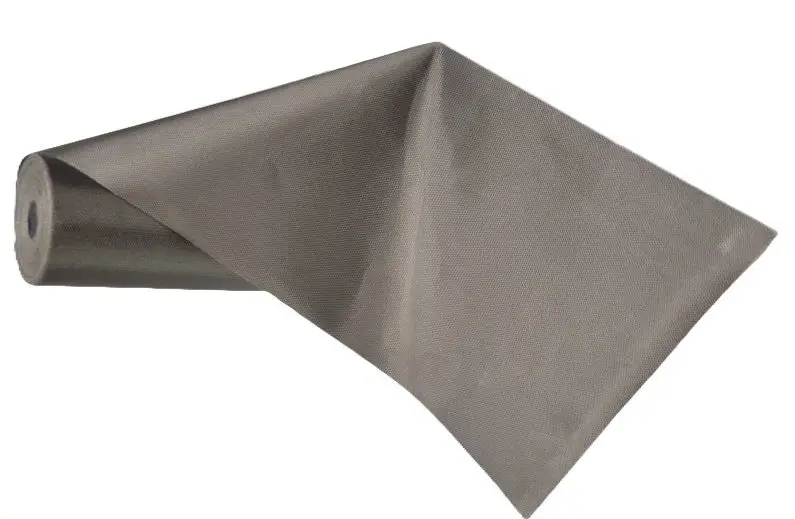
The patch material is an important part of the Tech-Bond repair system. Tech-Bond uses PTFE-coated E-glass fabric because it combines two very different sets of properties: the E-glass reinforcement provides strength and dimensional stability, while the PTFE coating provides a durable, chemically/fuel resistant surface.
Ordinarily, PTFE’s extremely low surface energy makes it one of the most difficult polymers to bond. Tech-Bond’s Polymer Bonding Process changes that equation by allowing the PTFE-coated fabric to become part of the bonded repair system.
Tech Patches — The Reinforcement Behind the Tech Patch Repair System (TPRS™)
Tech Patches are a key component of the Tech Patch Repair System™ (TPRS™), a bonded reinforcement system developed for the repair of damaged plastic and metal pipes and plastic and metal tanks. Rather than simply covering a crack, hole or deteriorated area, TPRS™ combines proper surface preparation, Tech-Bond’s bonding technology and reinforced Tech Patches to create a bonded repair extending beyond the damaged substrate. The system can be adapted to the size, material and severity of the damage, providing a practical repair-rather-than-replace approach for applications ranging from localized pipe damage to extensively deteriorated tank surfaces.
TPRS™, specifically Tech Wraps, is used to repair large pipes in a variety of industries. For commercial applications, at lease two layers of wrap are used.
Independent Research Supporting PTFE-Coated E-Glass Fabric
1. Strength and Long-Term Durability
Permanent Architectural Fabric Structures — Performance of the New Materials Technology (1987)
Published in Construction and Building Materials.
The research reports tensile strengths up to 150 kg/cm of fabric width and discusses service-life expectations of 25–30 years for architectural coated-glass fabrics.
Click tp read the scientific publication: https://pmc.ncbi.nlm.nih.gov/articles/PMC8746006/?utm_source=chatgpt.com
Access: Abstract available; full article may require purchase or institutional access.
2. PTFE Coating Improves Resistance to Degradation
Degradation of Polytetrafluoroethylene-Coated Glass Fiber Fabrics by Hot Water Treatment (1995)
Published by researchers at Kyoto Institute of Technology.
After 14 days in 90°C water:
- Uncoated glass fabric retained 31% of its tensile strength.
- PTFE-coated glass fabric retained 62%.
The research demonstrates the protective contribution of the PTFE coating under these test conditions.
Click to read the article and access the PDF: https://www.jstage.jst.go.jp/article/fiber1944/51/6/51_6_282/_article/-char/en?utm_source=chatgpt.com
Access: Free scientific publication with downloadable PDF.
3. Tensile Strength and Moisture Resistance
Water Influence on the Uniaxial Tensile Behavior of Polytetrafluoroethylene-Coated Glass Fiber Fabric (2021)
Published in Materials.
Researchers examined the mechanical performance of PTFE-coated glass fabrics under moisture exposure. They documented tensile-strength reductions of up to approximately 20%, depending on the material and conditions.
Click to read the complete scientific article: https://pmc.ncbi.nlm.nih.gov/articles/PMC7916629/?utm_source=chatgpt.com
Access: Free full text and PDF.
4. Additional Independent Durability Research
Influence of Water-Induced Degradation of PTFE-Coated Woven Fabrics Mechanical Properties (2021)
Published in Materials.
Researchers measured changes in tensile strength following water exposure, reporting reductions of approximately 5–16% across the materials and directions tested.
Click to read the complete scientific article: https://pmc.ncbi.nlm.nih.gov/articles/PMC7916629/?utm_source=chatgpt.com
Access: Free full text and PDF.