

The Economics Behind the Repair for large commercial operations to small businesses.
Picture a manufacturing facility or commercial operation at two o’clock in the morning. A pipe connection begins leaking, a polymer tank develops a crack or a critical equipment housing fails. The damaged area may be only a few inches long, but the production line stops. Operators stand idle. Maintenance personnel begin searching for a replacement component. A purchasing manager calls suppliers, only to learn that the required part has a four-week lead time. At that moment, the cost of the damaged component becomes almost irrelevant. The real financial loss is being measured in lost production, emergency labor, expedited shipping and every hour the facility remains silent.
Now picture a large water or wastewater pipe beneath a heavily traveled roadway. A conventional replacement may require excavation crews, traffic control, cranes, new pipe, specialized contractors, backfill, repaving and days—or weeks—of public disruption. Nearby businesses lose access. Residents face service interruptions. Municipal personnel are pulled away from other responsibilities. Yet the actual damage may be confined to one connector, one joint or one localized section of pipe. The physical problem may be small; the replacement project surrounding it can become enormous.
The same pattern appears across industrial and infrastructure operations. A failed connection can idle a mining conveyor. A damaged tank can interrupt a processing operation. Corrosion at an interface can take a marine system out of service. A cracked polymer component can immobilize an expensive piece of equipment while the organization waits for a replacement. In many cases, the largest expenses are not the materials used in the repair. They are mobilization, access, disassembly, replacement lead time, shutdowns and the cascading consequences of an asset that is no longer working.
The Revenue Savings Alternativve
Now picture the alternative. Instead of removing an entire pipe, tank or assembly, the organization evaluates whether the damaged area can be repaired in place. The surface is properly prepared. The patented Polymer Bonding Process™ establishes the foundation for the repair. TPRS™ reinforcement is installed. Poly Fill™ is used where additional geometry, support or load distribution is required. Poly Shield™ protects the completed system. The interfaces between the materials are deliberately engineered through Intelligent Interface Engineering™. The existing asset remains in place, and the work is concentrated where the failure actually occurred.
That is the economic difference illustrated by the chart. If the total cost of replacement—including removal, materials, equipment, labor and operational interruption—is represented by $100, a suitable repair-in-place application may cost only a fraction of that amount. The remaining dollars represent capital that can be preserved and redirected toward other assets, deferred maintenance, safety improvements or projects for which replacement truly is the only responsible option. The precise savings will differ by project, but the financial principle remains consistent: avoid replacing the entire asset when the damaged portion can be safely and effectively engineered back into service.
The savings can extend well beyond the maintenance budget. Every avoided shutdown protects production. Every avoided excavation reduces traffic disruption and restoration costs. Every repaired asset reduces demand for replacement materials, transportation and disposal. Every additional year of useful asset life gives the organization more time to plan capital expenditures rather than reacting to emergencies. A successful repair does more than solve a physical problem—it protects cash flow, operating continuity and the organization’s ability to invest strategically.
This becomes even more important during periods of economic pressure. Capital budgets tighten, borrowing becomes more expensive and replacement costs continue to rise. Organizations that have developed the ability to repair and extend the life of existing assets will be better positioned than those that remain dependent upon removal and replacement. Repair capability becomes a form of economic resilience.
The Alternative
Not every damaged asset should be repaired. Safety, engineering requirements and operating conditions must always control the decision. But when an asset can be safely restored, unnecessary replacement is not merely inconvenient—it is an avoidable use of capital. Tech-Bond helps industrial and infrastructure organizations identify those opportunities, validate the repair through a controlled pilot and document both the technical performance and the financial savings.
Schedule a Commercial Repair and Savings Review.. Let us examine the failures that are costing your organization the most—and determine what can be repaired, what can be preserved and how much can be saved.
Before You Replace It, Let Us Evaluate It
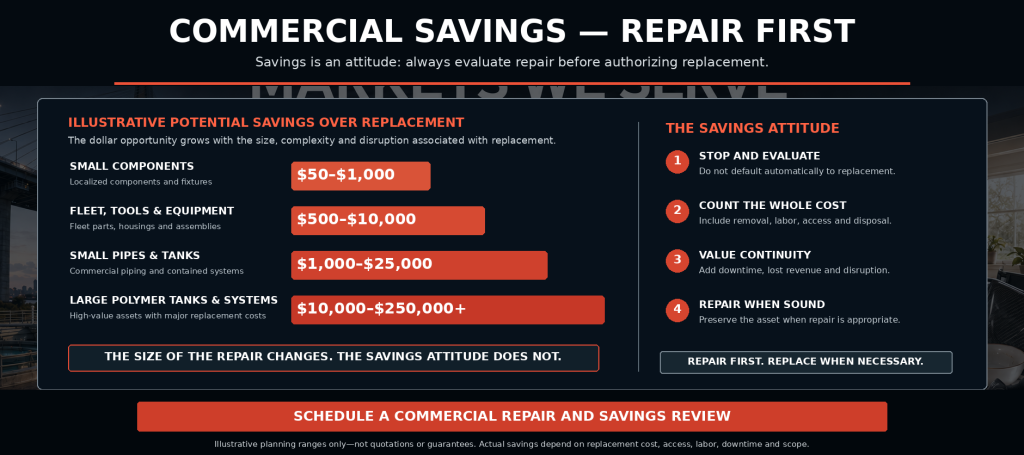
Every damaged component, pipe, tank, vehicle part or piece of equipment presents an opportunity to preserve capital. Whether the potential savings are hundreds of dollars or hundreds of thousands, the first step is the same: determine whether the asset can be safely and effectively repaired before committing to replacement.
Tell Tech-Bond what failed, what material it is made from and what replacement would require. We will help evaluate the application, identify an appropriate repair approach and estimate the potential savings—including labor, downtime, removal, replacement and operational disruption.
Schedule a Commercial Repair and Savings Review