Introduction
Bonding PVC to wood is one of the most common adhesion problems for contractors and serious DIYers — and one of the most mishandled. The materials show up together constantly: trim work, outdoor furniture, construction panels, plumbing fixtures. Yet most people reach for the wrong adhesive and wonder why the joint fails.
The core problem is chemistry. PVC's low surface energy (roughly 38–41 mN/m) actively resists adhesion, while wood is porous and moisture-sensitive. Standard woodworking glues simply don't work on PVC.
The right adhesive, applied correctly with proper surface prep, is the difference between a joint that holds for years and one that peels apart within weeks. This guide tells you exactly which adhesive types work, how to apply them, and how to match the solution to your specific situation.
Summary
- PVC's low surface energy prevents most standard glues from forming durable bonds without surface prep
- Construction adhesive is the go-to choice for PVC boards or trim bonded to wood
- Epoxy delivers high structural strength; cyanoacrylate works for small, quick repairs
- Surface preparation — cleaning, degreasing, light sanding — is essential before applying any adhesive
- Industrial applications demanding extreme durability benefit from molecular bonding technology, which bonds at the surface level rather than sitting on top like glue
Why Is Bonding PVC to Wood So Difficult?
The Surface Energy Problem
Adhesion depends on a liquid adhesive's ability to "wet out" or spread across a substrate. PVC is a low-surface-energy plastic, measuring between 38 and 41.5 mN/m. This puts it in the difficult-to-bond category — lower than wood (30–50 mN/m) and far below metals like aluminum (840 mN/m).
When you apply standard woodworking glue (PVA) to PVC, the adhesive beads up rather than spreading. PVA relies on porous substrates to absorb water and create mechanical interlocking with wood fibres. Because PVC is 100% non-porous, the moisture cannot escape, preventing proper cure.
Thermal Expansion Mismatch
PVC and wood expand and contract at very different rates when temperature and humidity change. Rigid PVC expands at roughly 66.2 µm/m-°C, while wood parallel to grain expands at just 3.1 to 4.5 x 10^-6 /K, approximately 15 to 20 times slower.
This coefficient of thermal expansion (CTE) mismatch creates massive shear stress during temperature fluctuations. Rigid adhesives that can't flex will eventually crack or delaminate at the joint, which is the primary reason standard woodworking glue fails on PVC.
PVC Variants and Their Bonding Requirements
You'll encounter two main PVC types:
- Rigid PVC (uPVC): Unplasticized, hard, and brittle, used in pipes, boards, and trim
- Foamed/Cellular PVC: Expanded PVC with a solid outer skin and cellular core, commonly used in trim and decorative applications
Rigid PVC accepts stronger structural adhesives, while foamed PVC's softer surface requires more flexible adhesives and often benefits from primer application.
Best Adhesives to Bond PVC to Wood
No single "best" adhesive exists for every PVC-to-wood application. The right choice depends on bond area, load requirements, environmental exposure, and PVC type.
Construction Adhesive (Best for PVC Trim and Boards on Wood)
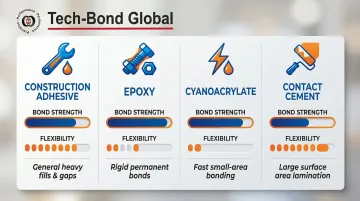
Construction adhesive (also called panel adhesive) is the most commonly recommended choice for bonding PVC boards, trim, and siding to wooden substrates. It fills minor surface gaps, tolerates differential movement between PVC and wood, and is available in formulations suitable for exterior use.
Critical requirement: Check the label for PVC compatibility — not all formulations bond well to plastic. Premium options like Loctite PL Premium achieve 305 psi shear strength on PVC-to-pine joints.
| Characteristic | Performance |
|---|---|
| Bond Strength | High — suitable for structural trim and panel installation |
| Flexibility After Cure | Moderate to high — accommodates PVC-wood expansion mismatch |
| Best For | PVC trim boards, crown molding, baseboard, siding installation to wood framing |
Epoxy (Best for Structural and Load-Bearing Bonds)
Two-part epoxies (resin + hardener) form extremely strong, rigid bonds and work well on rigid PVC bonded to wood when structural integrity is required. Toughened formulations like 3M Scotch-Weld 2216 deliver 940 psi shear strength on PVC while maintaining enough flexibility to absorb thermal movement.
Proper surface prep is critical: lightly sand both PVC and wood, then clean with isopropyl alcohol before application.
| Characteristic | Performance |
|---|---|
| Bond Strength | Very high — 180 to 940 psi depending on formulation |
| Flexibility After Cure | Low to moderate — toughened epoxies perform better under thermal cycling |
| Best For | Rigid PVC panels mounted to wood in load-bearing or structural applications |
Cyanoacrylate / Super Glue (Best for Quick Repairs and Small Bond Areas)
Cyanoacrylate (CA glue) bonds quickly to rigid PVC and wood for small-scale repairs or assembly. Surface-insensitive formulations like Loctite 401 achieve 1,450 psi shear strength on PVC, but brittleness and moisture sensitivity limit their use to indoor, small-area applications.
| Characteristic | Performance |
|---|---|
| Bond Strength | Moderate to high — strong in tension but brittle under peel or impact |
| Flexibility After Cure | Very low — can crack under vibration or thermal stress |
| Best For | Small repairs, hobby and craft projects, precise positioning before mechanical fastening |
Contact Cement (Best for Large Surface Areas and Flat Panel Bonding)
Solvent-based contact cement bonds on contact, making it efficient for large flat surfaces like gluing PVC sheeting or trim panels to wood substrates without clamping. It's heat, moisture, and oil resistant when fully cured.
Critical technique: Both surfaces must be coated, allowed to become touch-dry, then pressed together with firm pressure. No repositioning is possible after contact.
| Characteristic | Performance |
|---|---|
| Bond Strength | High initial grab; long-term bond is durable in dry and moderate-moisture environments |
| Flexibility After Cure | Moderate — some resistance to differential movement |
| Best For | Large PVC sheet-to-wood panel bonding, PVC fence components, laminate-style applications |
Molecular Bonding Technology (Best for Industrial and Permanent Applications)
Where conventional adhesives rely on surface-level grip, molecular bonding systems create crosslinks directly between substrates at the molecular level. This produces permanent bonds that hold under chemical exposure, sustained pressure, and extreme temperatures — conditions that cause standard adhesives to delaminate over time.
The technology is suited to industrial use cases: pipeline repair, infrastructure maintenance, and heavy-assembly environments rather than household DIY.
| Characteristic | Performance |
|---|---|
| Bond Strength | Permanent — crosslinked at the molecular level, exceeds substrate strength in many applications |
| Flexibility After Cure | Application-dependent — engineered for thermal cycling, pressure, and chemical resistance |
| Best For | Industrial pipeline repair, infrastructure bonding, heavy-assembly environments requiring permanent bonds |
Tech-Bond Global's patented molecular bonding system is designed for exactly these demands. For technical consultation on industrial applications, call +1 877-565-7225.
How to Bond PVC to Wood: Step-by-Step Guide
Step 1 — Surface Preparation
Both surfaces must be thoroughly cleaned to remove dust, oil, and grease using isopropyl alcohol or an appropriate solvent cleaner.
For PVC: Lightly sand the surface with 180-grit sandpaper or finer to increase surface roughness and improve adhesive wetting. Never use coarser grits, which can create deep scratches. Avoid acetone or MEK — they can attack or melt the plastic.
For wood: Remove any finish, varnish, or contamination. Clean with isopropyl alcohol.
Even a thin film of contamination is enough to cause bond failure.
Step 2 — Priming (Where Required)
For hard/rigid PVC bonded to wood, some adhesive systems — particularly construction adhesive and hybrid sealant adhesives — benefit from a compatibility primer applied to the PVC surface.
Primer is especially important for foamed PVC, where the cardboard-like outer skin needs preparation before adhesive is applied. Check your adhesive manufacturer's recommendations.
Step 3 — Adhesive Application
Apply adhesive using the correct technique for your chosen product:
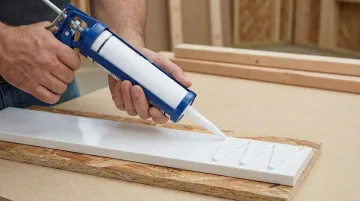
- Construction adhesive: Continuous bead or zigzag pattern on the back of the PVC component
- Contact cement: Even coat across both surfaces, allowed to dry until tacky
- Two-part adhesives (epoxy): Follow manufacturer's mix ratio precisely
Avoid applying too much adhesive — excess does not improve bond strength and causes mess and long cure times.
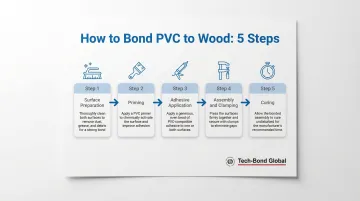
Step 4 — Assembly and Clamping
Once adhesive is applied, press the PVC piece firmly into place and hold under pressure until initial cure is achieved.
Clamping requirements vary by adhesive type:
- Construction adhesive: Supplement with a few nails or screws to reduce clamping time and reinforce the bond during cure
- Contact cement: No clamping required, but apply firm, even pressure across the full bond area immediately on contact — use a J-roller at minimum 25 psi, working from center to edges
Step 5 — Curing and Post-Care
Let the bond fully cure before applying any mechanical stress or load to the joint.
Typical cure times:
- Construction adhesive: 30–60 minutes handling strength, 24 hours full cure
- Epoxy: 5 minutes to 12 hours depending on formulation, 7 days maximum strength
- Contact cement: Instant on contact, 7 days full cure
Moisture, temperature, and bond area affect cure speed. Always follow manufacturer's instructions.
How to Choose the Right Adhesive for Your Project
Picking the wrong adhesive wastes time and risks a failed bond. These three factors narrow your options fast.
Key Decision Factors
Bond area size:
- Small repairs: Cyanoacrylate
- Large panels: Contact cement or construction adhesive
Load and stress type:
- Structural/load-bearing: Epoxy or construction adhesive
- Minimal stress: Any compatible adhesive
Environmental exposure:
- Outdoor, wet, or chemical environments: Weather-resistant construction adhesive or industrial-grade formulations
- Indoor, dry: Most adhesives suitable
Surface type:
- Foamed (foam-core) PVC: Use a flexible adhesive and apply primer first — the softer surface won't hold rigid formulations well
- Hard rigid PVC: Structural adhesives like epoxy or construction adhesive work best
Common Mistakes to Avoid
- PVA (wood glue) won't bond PVC — it relies on porous substrates for mechanical grip, and PVC gives it nothing to hold.
- Skipping sanding kills adhesion — PVC's smooth, low-energy surface needs abrasion before any adhesive will stick.
- Dirty surfaces prevent bonding — manufacturing residues and contamination block adhesive contact; always degrease first.
- PVC pipe cement is not a substitute — solvent cement chemically fuses two PVC surfaces together and has no mechanism for bonding PVC to wood.
Conclusion
Bonding PVC to wood comes down to three factors: the right adhesive for your application, proper surface preparation, and consistent technique. Match the adhesive to the job:
- Construction adhesive — everyday trim, molding, and general installs
- Epoxy — structural joints requiring maximum strength
- CA glue — fast fixes and small repairs
- Contact cement — large panel bonding with broad surface coverage
For high-demand applications where long-term durability, chemical resistance, or harsh environmental exposure matter, conventional adhesives have real limitations. Tech-Bond Global's patented molecular bonding process creates permanent crosslinks at the surface level rather than relying on adhesive films, making it the stronger choice for critical industrial PVC bonding.
For guidance on the right approach for your specific application, reach out to Tech-Bond Global's team directly at +1 877-565-7225 or visit the website for a technical consultation.
Frequently Asked Questions
What is the best adhesive for PVC to wood?
Construction adhesive is the most widely recommended choice for PVC-to-wood bonding in most applications — it's flexible, gap-filling, and compatible with both materials. The best option depends on bond area size, load requirements, and environmental exposure.
Can you stick wood to PVC?
Yes, wood can be bonded to PVC, but the bond requires proper surface preparation (cleaning, light sanding) and an adhesive suited to both substrates. Standard wood glue will not work because it cannot adhere to PVC's low-energy surface.
Does epoxy work for bonding PVC to wood?
Two-part epoxy can form a strong bond between rigid PVC and wood when both surfaces are properly prepped, but it cures rigid and may crack under thermal cycling. Use toughened epoxy for structural, low-movement joints only.
Do I need to prime PVC before gluing it to wood?
Priming is not always required but is strongly recommended for foamed PVC and when using construction adhesive or hybrid sealant adhesives. A compatible primer improves adhesive wetting and extends bond durability.
What is the difference between PVC cement and construction adhesive for wood bonding?
PVC cement (solvent cement) works by chemically dissolving and fusing two PVC surfaces together. It bonds PVC-to-PVC only and will not bond PVC to wood. Construction adhesive is a surface adhesive that works on dissimilar materials including PVC and wood.
How do I prepare PVC for bonding to wood?
Follow these steps before applying any adhesive:
- Wipe both surfaces with isopropyl alcohol to remove grease and contamination
- Lightly sand the PVC surface with 180-grit sandpaper to increase roughness
- Apply primer if required by the adhesive manufacturer
- Apply adhesive promptly while surfaces are clean and prepped