
Introduction
Scroll through health news, check your cookware labels, or research industrial materials, and you'll encounter the same question: Is PTFE safe? PTFE appears on non-stick pans, medical implants, aerospace components, and headlines about "forever chemicals"—yet the information is often contradictory. Some sources warn against it entirely, while regulatory bodies approve it for food contact.
The answer depends on context: how PTFE is used, at what temperature, and how it differs from related chemicals like PFOA and the broader PFAS family. PTFE itself is a stable, chemically inert polymer with a strong safety record under normal conditions.
The real concerns historically stemmed from PFOA, a toxic processing chemical phased out of manufacturing by 2015. What follows is a science-backed breakdown of PTFE's safety across everyday cookware and demanding industrial applications.
Key Takeaways
- PTFE is chemically inert under normal use conditions and approved by FDA and EFSA for food contact
- PFOA—the chemical linked to serious health risks—was eliminated from PTFE manufacturing by 2015
- Overheating above 320°C (610°F) is the primary consumer risk; normal cooking stays well below this threshold
- PTFE is technically a PFAS but behaves very differently from the short-chain PFAS compounds linked to documented health harm
- Industrial applications leverage PTFE's exceptional chemical resistance with robust safety protocols
What Is PTFE? Understanding the Material
PTFE (polytetrafluoroethylene) is a synthetic fluoropolymer composed of carbon atoms bonded to fluorine atoms in a highly stable molecular chain (–CF₂–CF₂–). This carbon-fluorine bond is one of the strongest in organic chemistry, with a bond dissociation energy of approximately 485 kJ/mol. That extraordinary strength gives PTFE its signature properties: near-total chemical inertness, extremely low friction (coefficient of 0.05–0.08 static), and exceptional thermal stability under continuous service conditions.
Core PTFE properties:
- Melting point: ~327°C (621°F)
- Maximum continuous service temperature: 260°C (500°F)
- Chemically resistant to virtually all industrial solvents and acids
- Non-reactive with body chemistry and food
PTFE's applications extend far beyond the kitchen. These properties make it valuable across multiple engineering sectors:
- Medical devices: catheters, implants, guidewires
- Aerospace and automotive: high-temperature wire insulation, fuel hoses, seals
- Chemical processing: corrosion-resistant pipe liners, gaskets, tank coatings
- Industrial fabrics: filter bags, architectural membranes, protective coatings
PTFE is technically classified as a fluoropolymer within the broader PFAS (per- and polyfluoroalkyl substances) family. Its high-molecular-weight polymer structure, however, makes it behave in a distinctly different way from the short-chain PFAS chemicals most associated with environmental and health harm.
That distinction matters for the safety debate. PTFE's large, stable molecules are insoluble in water and fats, do not bioaccumulate in living tissue under normal conditions, and lack the environmental mobility of smaller PFAS compounds.
PTFE, PFOA, and PFAS: What's the Difference?
Understanding the PFAS Family
PFAS (per- and polyfluoroalkyl substances) is an umbrella term covering thousands of synthetic fluorinated compounds, often called "forever chemicals" because they resist environmental breakdown. Not all PFAS carry equal risk—hazard profiles vary considerably based on molecular size, water solubility, and persistence in living tissue. Short-chain PFAS like PFOA and PFOS are highly mobile, bioaccumulative, and linked to serious health outcomes. High-molecular-weight polymers like PTFE are chemically stable and inert.
The PFOA Problem and Phase-Out
PFOA (perfluorooctanoic acid) is a short-chain PFAS that was historically used as a processing aid during PTFE manufacturing—not as a component of the finished PTFE polymer itself. Research linked PFOA to severe health concerns:
- Cancer: The International Agency for Research on Cancer (IARC) classified PFOA as Group 1—"carcinogenic to humans", linked to testicular and kidney cancer
- Reproductive harm: Associated with pregnancy-induced hypertension, preeclampsia, and decreased birth weight
- Metabolic effects: Elevated LDL cholesterol and liver damage
- Immune suppression: Presumed immune hazard that suppresses antibody response to vaccines
By the early 2000s, CDC biomonitoring data showed PFOA was detectable in a large share of the U.S. population, with a geometric mean serum concentration of 3.92 ng/mL in 2005–2006.
In response, the EPA launched the PFOA Stewardship Program in 2006, targeting a 95% reduction by 2010 and total elimination by 2015. All eight major manufacturers—including DuPont, 3M, and Daikin—successfully met the 2015 elimination goals. Since then, modern PTFE products, including cookware, are manufactured PFOA-free. When you see "PFOA-free" labels, this is accurate and meaningful for health.
What Makes PTFE Different from Harmful PFAS
PTFE is fundamentally different from short-chain PFAS like PFOA:
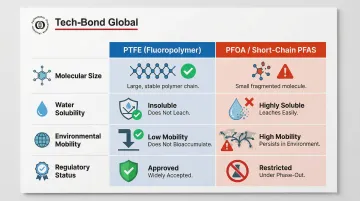
| Characteristic | PTFE | PFOA (Short-Chain PFAS) |
|---|---|---|
| Molecular size | High-molecular-weight polymer | Small, mobile molecule |
| Solubility | Insoluble in water and fats | Water-soluble and bioaccumulative |
| Environmental mobility | Non-migratory; stays localized | Spreads widely in groundwater and soil |
| Regulatory food contact approval | FDA-approved under 21 CFR 177.1550; EFSA: not a major dietary PFAS source | Not approved for food contact |
| Health risk profile | Safe under normal use conditions | Carcinogenic; reproductive and immune harm |
Lifecycle Concerns and EU Regulatory Trends
The safety debate around PTFE has shifted from in-use exposure to what happens across its full lifecycle. Two concerns drive current regulatory attention:
- Manufacturing emissions: Producing fluoropolymers historically required PFAS processing aids like PFOA, which could result in environmental releases during production
- End-of-life incineration: Burning PTFE at standard municipal waste temperatures may not fully mineralize the polymer, potentially releasing trifluoroacetic acid (TFA) and greenhouse gases
Five EU member states have submitted a universal PFAS restriction proposal to the European Chemicals Agency (ECHA) that includes fluoropolymers like PTFE. Scientific evaluation runs through 2026, with expected derogations for industrial and medical applications where no substitutes exist. For most manufacturers and end users, this means continued access under current conditions—but it's worth monitoring whether stricter disposal or production rules emerge from the final ruling.
Is PTFE Safe? What the Science Actually Says
Direct Answer: PTFE Is Not Toxic Under Normal Use
Under normal use conditions, PTFE itself is not toxic to humans. It is chemically inert, does not dissolve into food or water, and does not react with body chemistry. The FDA approves PTFE for food-contact use, and EFSA's 2020 assessment confirmed it poses negligible migration risk.
The Cancer Question
The American Cancer Society (ACS) explicitly states (updated 2024): "There are no proven risks to humans from using cookware coated with Teflon (or other non-stick surfaces)." The ACS clarifies that because PTFE molecules are polymerized and tightly bound, "very little is capable of getting into food."
The historical cancer concern was tied to PFOA exposure during manufacturing, a distinct issue now addressed by the phase-out. PTFE itself has not been shown to be carcinogenic. The more practical concern for everyday users isn't cancer — it's what happens when a pan gets dangerously hot.
Polymer Fume Fever ("Teflon Flu")
Inhalation of PTFE thermal degradation products can cause polymer fume fever, a temporary flu-like illness with symptoms including:
- Fever and chills
- Sore throat and chest tightness
- Dry cough and muscle aches
This is primarily an occupational health concern in industrial processing environments. In consumer cookware settings, it requires extreme misuse — such as preheating an empty pan on maximum heat for extended periods — to reach dangerous temperatures.
Pet birds are a notable exception. The Merck Veterinary Manual documents that PTFE toxicosis causes acute respiratory distress in birds and can be lethal at temperatures as low as 280°C (536°F) — far below the threshold that harms humans.
Regulatory Status and Risk Summary
Regulators consistently find PTFE safe when used as intended. The remaining concerns are narrow and well-defined:
- Production processes (PFOA emissions, now largely phased out)
- Extreme overheating and fume release
- Long-term environmental persistence at end-of-life
When Does PTFE Become Dangerous? Temperature and Risk Thresholds
Key Temperature Thresholds
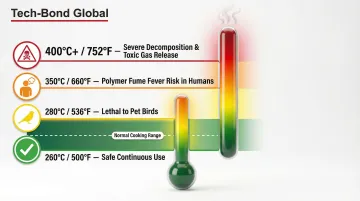
PTFE is stable and inert below approximately 260°C (500°F), which covers all normal stovetop cooking. Above 320–350°C (610–660°F), PTFE begins to degrade and may release fumes.
| Temperature | Effect | Source |
|---|---|---|
| 260°C (500°F) | Maximum continuous service temperature; slow depolymerization begins | Chemours PTFE technical data |
| 280°C (536°F) | Fumes become lethal to pet birds | Merck Veterinary Manual |
| 350–360°C (610–660°F) | Fumes can cause polymer fume fever in humans | NIOSH reports |
| >400°C (752°F) | Significant decomposition; release of highly toxic perfluoroisobutylene (PFIB) and carbonyl fluoride | NIOSH industrial hygiene studies |
Real-World Cooking Temperatures
Typical cooking methods stay well below PTFE's degradation point:
- Boiling water: ~100°C
- Sautéing and frying with oil: 110–250°C
- Normal stovetop use: Under 260°C
Reaching dangerous temperatures requires specific misuse — leaving an empty pan on high heat, using a broiler setting with non-stick bakeware, or simply forgetting a pan on the burner. How fast does that happen? An Environmental Working Group (EWG) test found that an empty PTFE-coated pan on a high electric burner hit 391°C (736°F) in just 3 minutes and 20 seconds.
Signs of Coating Degradation
Replace PTFE cookware when you notice:
- Visible scratching, peeling, or flaking of the coating
- Discoloration or dullness after high-heat exposure
- Food sticking frequently despite proper preparation
Ingesting small flakes poses minimal health risk. The German Federal Institute for Risk Assessment (BfR) confirms that PTFE particles are not digested and are excreted unchanged. That said, a visibly degraded coating is a reliable signal the pan has reached the end of its useful life.
Safe Cooking Temperature Guidance
Replacing worn cookware is the first step — pairing it with better habits keeps new pans in good condition longer:
- Stick to low-to-medium heat settings
- Never preheat empty non-stick pans
- Use exhaust ventilation during cooking
- Avoid metal utensils that scratch the surface
- Store cookware carefully to prevent surface damage
PTFE in Industrial Applications: Beyond the Kitchen
Why PTFE Is Critical in Demanding Environments
PTFE's chemical and physical properties make it uniquely valuable in industrial settings where other materials fail:
- Resistance to virtually all industrial chemicals and solvents
- Performance across extreme temperature ranges (-200°C to +260°C)
- Lowest coefficient of friction of any solid material
- Excellent electrical insulation properties
Major industrial applications:
- Seals and gaskets in chemical processing equipment
- Liners in pipes and storage tanks handling corrosive fluids
- Wire and cable insulation for aerospace and high-temperature environments
- Medical tubing and implantable devices
- Industrial fabric coatings for filtration and architectural membranes
Industrial Safety Protocols and Standards
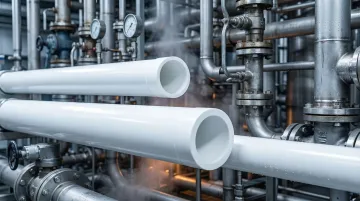
In industrial applications, PTFE operates under controlled conditions with strict engineering standards. For example, ASTM F1545-15a specifies requirements for plastic-lined ferrous metal pipe used to convey highly corrosive fluids, mandating that paste-extruded PTFE liners maintain minimum tensile strength of 2,500 psi and 200% elongation to prevent catastrophic chemical leaks.
Industrial health and safety protocols specifically address overheating risks during processing and fabrication — the conditions where PTFE's only real hazards emerge. In end-use structural assemblies, those thermal exposure risks don't exist. PTFE's chemical inertness, which makes it safe as a cookware coating, becomes an even stronger safety asset when the material is sealed inside piping systems or chemical processing equipment with no direct user contact.
Tech-Bond Global leverages PTFE's exceptional properties in its Tech Patch Repair System (TPRS), which uses PTFE-coated E-glass fabric for permanent industrial pipe and infrastructure repairs. The PTFE coating gives the patch fabric resistance to a broader range of chemicals and higher sustained temperatures than standard fiberglass — critical performance factors when repairing pipes carrying corrosive or high-pressure fluids.
Environmental Considerations in Industrial Use
Responsible use of PTFE in long-life industrial systems can reduce replacement frequency and associated waste compared to less durable materials. End-of-life management practices in industrial settings — such as controlled disposal and recycling programs — differ significantly from consumer incineration and directly shape PTFE's overall environmental footprint.
How to Use PTFE-Coated Products Safely
PTFE cookware is safe under normal use — but a few habits make a real difference. Here's what to follow, and what to consider if you'd rather skip PTFE altogether.
Practical Guidance for Cookware
Follow these practices to keep PTFE cookware safe and effective:
- Use low-to-medium heat – High heat is unnecessary and risks degradation
- Never preheat empty pans – Always add oil or food before heating
- Choose appropriate utensils – Use wood, silicone, or nylon (not metal)
- Hand wash with mild soap – Dishwashers can degrade coatings over time
- Replace damaged cookware – Discard pans with visible scratching, peeling, or flaking
Alternatives to PTFE Cookware
If you prefer to avoid PTFE entirely, several PFAS-free alternatives exist:
| Material | PFAS Status | Performance Characteristics |
|---|---|---|
| Ceramic Coatings | PFAS-Free (sol-gel silica/metal oxides) | Good initial non-stick performance; degrades faster than PTFE under mechanical wear |
| Stainless Steel | PFAS-Free | Highly durable and heat-resistant; requires oils to prevent sticking |
| Cast Iron (Bare & Enameled) | PFAS-Free | Extremely durable; develops natural non-stick patina when seasoned |
| Carbon Steel | PFAS-Free | Lighter than cast iron; requires manual seasoning for non-stick surface |
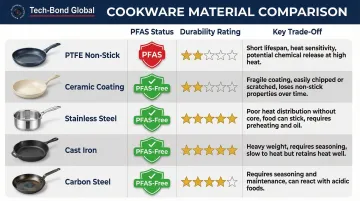
Each option has real trade-offs. Cast iron and carbon steel are the most durable long-term choices, while ceramic coatings — despite their PFAS-free appeal — wear out significantly faster than PTFE under standardized abrasion testing. Your best pick depends on how you cook, not just what you want to avoid.
Frequently Asked Questions
Is PTFE toxic to humans?
No, PTFE is not considered toxic under normal use conditions. It is chemically inert, does not dissolve in body fluids, and is recognized as safe for food contact by the FDA and EFSA. Risk arises primarily from extreme overheating above 320°C, not ordinary exposure.
Is PTFE as bad as PFOA?
No. PFOA was a processing chemical used in PTFE manufacturing, linked to serious health concerns including cancer, liver damage, and immune suppression, and phased out since 2015. PTFE itself is a stable polymer with a substantially safer and more inert profile than PFOA.
Is PTFE the same as Teflon?
Yes and no. Teflon® is The Chemours Company's brand name for PTFE, so all Teflon is PTFE. However, PTFE appears across many industries beyond cookware, including medical devices, aerospace components, and industrial coatings.
What temperature does PTFE become dangerous?
PTFE begins to degrade above approximately 320–350°C (610–660°F), releasing fumes that can cause flu-like symptoms. Normal cooking temperatures stay well below this threshold. The risk is mainly from extreme misuse such as preheating an empty pan on maximum heat.
Does "PFOA-free" mean PFAS-free?
No. PFOA-free means the product was manufactured without PFOA, which is meaningful and accurate for health. However, PTFE itself is technically a PFAS (a fluoropolymer), so a PFOA-free PTFE pan is not the same as a PFAS-free pan.
Is PTFE safe in industrial applications like pipe coating or repair systems?
Yes. PTFE is widely used and well-validated in industrial applications such as pipe liners, seals, and coated fabrics because of its chemical resistance and thermal stability. Industrial processing environments follow strict protocols and engineering standards that address any overheating risks during manufacturing.