Introduction
Select the wrong material for a chemically aggressive, wet environment and the cost shows up fast — in corroded fittings, contaminated process streams, and unplanned downtime. Traditional materials either degrade under chemical attack, absorb moisture, or fail to hold up under thermal cycling. PTFE's hydrophobicity addresses this at the molecular level: not surface-level water repellency, but a structural chemical architecture that determines how the material performs under heat, chemical exposure, and mechanical stress.
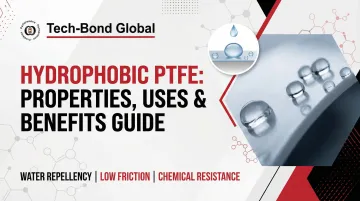
This guide covers why PTFE repels water, how that behavior is measured through contact angle, and what conditions can compromise it. More practically, it maps where PTFE's hydrophobicity creates real industrial value — across chemical processing, aerospace wiring, medical devices, and field-repair applications — so you can make a more confident material selection decision.
Key Takeaways
- PTFE's hydrophobicity stems from densely packed carbon-fluorine bonds creating surface energy of just 18–20 mN/m—water cannot wet it
- Water contact angles on standard PTFE surfaces measure 108°–115°; nanostructured coatings push this above 150°
- Hydrophobicity drives chemical inertness, near-zero friction (0.05–0.10 CoF), near-zero moisture absorption, and dielectric stability
- Degrades through abrasion, contamination, UV overexposure, or sustained heat above 260°C
- Applications include chemical pipe liners, medical coatings, aerospace insulation, and industrial repair systems built on PTFE-coated fabrics
What Makes PTFE Hydrophobic: The Molecular Science Behind Water Repellency
PTFE's hydrophobicity comes from its molecular structure, not from applied coatings or surface treatments. In engineering terms, hydrophobicity describes a surface's tendency to repel water due to thermodynamic incompatibility between the surface and polar water molecules.
PTFE is a fully fluorinated carbon-chain polymer with the chemical formula (C₂F₄)ₙ. Every hydrogen atom found in polyethylene is replaced by fluorine, producing a densely shielded structure that water cannot wet or bond to.
The Role of Carbon-Fluorine Bonds
Carbon-fluorine bonds are among the strongest in organic chemistry, with a bond dissociation energy of approximately 513.8 ± 10.0 kJ/mol. Fluorine's extremely low electric polarizability means only weak London dispersion forces can form between PTFE and other molecules—making water adhesion thermodynamically unfavorable.
Surface Energy: Why Water Beads and Rolls Off
PTFE has one of the lowest known surface energies of any solid material. Published values consistently fall in the range of 18.0–20.0 mN/m, while water's surface tension is 72.74 mN/m at 20°C. This massive gap explains why water cannot spread across PTFE—the molecular attraction required for wetting simply doesn't exist.
Factors That Influence Hydrophobicity in Real-World Use
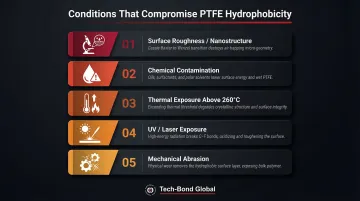
While the molecular mechanism is fixed, realized hydrophobic performance depends on:
| Degradation Factor | Mechanism | Impact on Hydrophobicity | Mitigation |
|---|---|---|---|
| Surface roughness variation | Cassie-Baxter vs. Wenzel wetting regimes affect air pocket formation | Directly affects contact angle performance | Maintain clean, smooth surface |
| Chemical/oil contamination | Lowers effective surface energy | Reduces water repellency | Clean with appropriate solvents |
| Thermal exposure >260°C | Degrades surface architecture | Structural breakdown of surface | Keep within continuous service limit |
| High-intensity UV/excimer | Photodegradation at extreme intensities | Surface layer breakdown | Avoid intense UV in precision applications |
| Mechanical abrasion | Disrupts fluoropolymer surface layer | Reduces contact angle | Prevent physical scratching and contact |
Quantifying PTFE Hydrophobicity: Contact Angle, Performance Range, and Operational Limits
Water contact angle (WCA) is the primary metric for quantifying hydrophobicity. Surfaces above 90° are hydrophobic; above 150° are superhydrophobic. The sessile drop method measures WCA by placing a water droplet on a flat PTFE surface and recording the tangent angle at the contact line.
Nominal Contact Angle Range for PTFE
Bulk/sintered PTFE typically exhibits WCA in the range of 108°–115° under standard conditions. This is measured on smooth, clean surfaces and represents baseline performance without surface modification.
These values hold under these assumptions:
- Clean surface free from oils or contaminants
- Ambient temperature (20–25°C)
- Non-polar or weakly polar test liquid
- Smooth, sintered PTFE surface
Aggressive polar solvents, surfactants, or process fluids with low surface tension can reduce contact angle performance.
Superhydrophobicity Through Surface Engineering
PTFE nanoparticle coatings or structured PTFE surfaces (e.g., PTFE-coated E-glass fabrics, porous ePTFE) can achieve WCA above 120° and approach superhydrophobic thresholds. PTFE films with silica nanoparticles reach 156°, and ion-plated PTFE coatings achieve 150°–160°.
This amplification occurs through the Cassie-Baxter model: air-water interfaces (plastron layers) form within surface micro-cavities, creating a composite surface where water contacts both PTFE and trapped air—pushing the apparent contact angle well beyond what the flat PTFE surface alone would produce.
Safe Operating Margin for Hydrophobic Performance
Surface engineering can push WCA higher, but thermal limits determine how long those gains hold in service. PTFE's hydrophobic and structural stability tops out at approximately 260°C for continuous use. Above this threshold, decomposition begins and surface properties degrade — even though the melting point sits higher at 327°C.
For applications near that ceiling, this gap matters: PTFE can remain physically intact while losing its hydrophobic character, creating a failure mode that visual inspection alone won't catch.
Key Technical Properties of Hydrophobic PTFE
Chemical Inertness as a Function of Hydrophobicity
The same C-F bond density responsible for water repellency makes PTFE resistant to nearly all industrial acids, bases, solvents, and oxidizers. The few exceptions—alkali metals at elevated temperatures and fluorinating agents—are the only chemicals capable of disrupting C-F bonds.
This near-universal chemical resistance is why PTFE is specified for pipe liners, gaskets, and chemical containment where both water exclusion and chemical inertness are required.
Low Coefficient of Friction
PTFE has one of the lowest coefficients of friction of any known solid, typically 0.05–0.10. This arises from the same low London dispersion forces that drive hydrophobicity—the surface repels molecular adhesion generally, not just water.
Practical implications include:
- Bearing seals with minimal wear
- Sliding mechanisms requiring no lubrication
- Lined pipework with reduced pressure drop and fouling
Moisture Absorption, Dielectric Properties, and UV Behavior
PTFE exhibits near-zero moisture absorption (≤0.010% over 24 hours), which keeps PTFE dimensionally stable in wet environments—a direct result of its hydrophobicity. This same property drives its excellent dielectric performance: PTFE holds approximately 58.6% of the aerospace fluoropolymer market, used extensively for wire insulation in aerospace and electronics.
UV behavior adds another layer of application context. PTFE is transparent to UV light and withstands standard outdoor UV exposure without degradation — but high-intensity excimer laser UV causes surface breakdown, a limit engineers must account for in precision optical or laser-adjacent environments.
Industrial Applications Enabled by PTFE's Hydrophobic Properties
Chemical Processing and Pipeline Systems
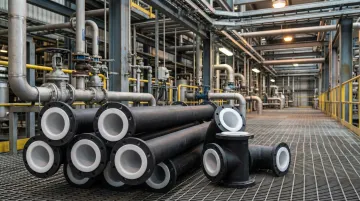
PTFE's hydrophobicity and chemical inertness make it the material of choice for lining pipes, hoses, expansion joints, and tanks handling corrosive or reactive fluids. The non-wetting surface prevents both chemical attack and fouling from deposited minerals or process residues.
The PTFE lined pipes and fittings market was valued at $1.225 billion in 2024 and is projected to reach $2.8 billion in 2025, reflecting widespread adoption in chemical processing sectors.
Medical Devices and Biomedical Surfaces
PTFE's hydrophobic surface reduces bacterial adhesion and biofilm formation. Studies show bacterial adhesion (E. coli, P. aeruginosa, C. jejuni) is lower on Teflon surfaces compared to ceramics due to its low surface energy—bacteria rely on weak van der Waals adhesion, which PTFE's surface limits.
Applications include:
- Catheter coatings
- Vascular grafts
- Surgical device surfaces requiring both biocompatibility and anti-fouling
Electronics, Aerospace, and Structural Composites
Hydrophobicity combined with zero moisture absorption makes PTFE a preferred insulation material across high-performance electrical and structural applications:
- Aerospace wiring and coaxial cables where moisture ingress causes signal degradation
- Printed circuit boards in microwave and RF applications requiring stable dielectric properties
- PTFE-coated fiberglass architectural membranes for stadium roofs, including Tropicana Field (1989), Paycor Stadium (2000), and NRG Stadium (2002), where weather resistance depends on sustained hydrophobic performance under UV and mechanical stress.
Industrial Repair and Field Applications Using PTFE-Coated Fabrics
PTFE-coated E-glass fabric combines the hydrophobicity and chemical resistance of PTFE with the tensile strength of woven glass fiber, creating a composite material suited for high-pressure, chemically aggressive repair environments.
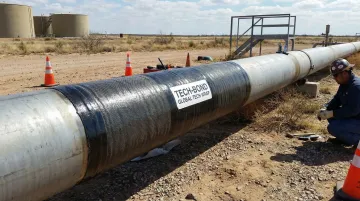
This material forms the basis for Tech-Bond Global's Tech Wraps and Tech Patch Repair System (TPRS)—field-deployable pipeline repair solutions rated for exposure to hydrocarbons, chemicals, and moisture.
The system's performance has been validated in the field: a 78-inch HDPE pipe repair for Borouge in Abu Dhabi (Spring 2023) confirmed through third-party testing that the repair exceeded the strength of the original pipe.
When PTFE Hydrophobicity Fails: Limits, Degradation, and Common Misinterpretations
Thermal and Chemical Degradation Boundaries
Continuous exposure above 260°C initiates PTFE decomposition and surface property degradation. Above 350°C, decomposition accelerates significantly. Above 380°C, pyrolysis releases hazardous fluorocarbon gases including hydrogen fluoride and perfluoroisobutylene (PFIB).
PTFE-coated cookware at normal cooking temperatures (well below 260°C) does not present these risks, but improper industrial use near heat sources or open flame can compromise both hydrophobic and structural properties.
Surface Damage, Contamination, and Creep
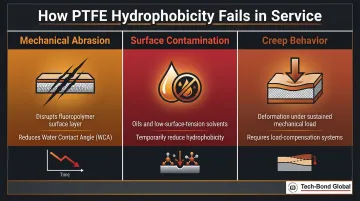
Practical failure modes include:
| Failure Mode | Mechanism | Observable Effect | Reversibility |
|---|---|---|---|
| Mechanical abrasion | Removes or disrupts fluoropolymer surface layer | Reduced water contact angle (WCA) | Permanent unless surface re-treated |
| Surface contamination | Oils, silicones, or low-surface-tension solvents coat surface | Temporarily reduced hydrophobicity | Reversible with appropriate cleaning |
| Creep behavior | Sustained compressive loads cause permanent deformation | Loss of sealing force; material flow | Requires design compensation (Belleville washers) |
These physical and mechanical failure modes are often compounded by misapplied assumptions about what PTFE can and cannot do.
Misinterpretations Engineers Should Avoid
Treating contact angle as absolute: Published nominal contact angles are measured under controlled conditions—process fluid chemistry, temperature, and surface contamination all affect real-world performance.
Assuming universal adhesion resistance: While PTFE repels water, low surface tension fluids including hexadecane, tetradecane, octane, and benzene have finite contact angles and can wet PTFE.
Confusing inertness with bondability: PTFE is difficult to bond due to its chemically inert surface — standard adhesives fail to form durable joints. Structural applications require surface activation chemistry followed by compatible bonding agents. Tech-Bond Global's Polymer Bonding Process addresses this directly: Poly Prep surface preparation activates the PTFE substrate, enabling structural cyanoacrylates to form molecular-level crosslinks rather than surface adhesion.
Frequently Asked Questions
Why is polytetrafluoroethylene hydrophobic?
PTFE is hydrophobic due to the density of carbon-fluorine bonds throughout its molecular structure. Fluorine's low polarizability means only negligible London dispersion forces exist at the surface. Polar water molecules cannot form sufficient attraction to wet or spread across it, producing contact angles above 108°.
Is polytetrafluoroethylene the same as Teflon?
Teflon is a brand name originally trademarked by DuPont and now owned by Chemours for PTFE-based products. All Teflon is PTFE, but not all PTFE is Teflon-branded—many manufacturers produce PTFE under different trade names, and the underlying polymer chemistry and hydrophobic properties are identical.
Is polytetrafluoroethylene (PTFE) harmful to human health?
PTFE itself is chemically inert and considered biocompatible at normal use temperatures. The primary historical concern involves PFOA, a processing aid now largely phased out under EPA's 2010/2015 PFOA Stewardship Program, not the polymer itself. Decomposition above 260°C does release hazardous fluorocarbon gases, so staying within rated temperature limits is essential.
What is the water contact angle of PTFE and why does it matter?
Standard PTFE surfaces exhibit a water contact angle of approximately 108°–115°, well above the 90° hydrophobic threshold. This measurement confirms that water will bead and roll off rather than spread, which directly translates to resistance against corrosion, fouling, bacterial adhesion, and moisture ingress in industrial and medical applications.
Can PTFE lose its hydrophobic properties over time?
PTFE's intrinsic hydrophobicity does not degrade chemically under normal conditions. Surface performance can decline, however, through mechanical abrasion, contamination from low-surface-tension fluids, or sustained temperatures above 260°C. Regular inspection and avoiding abrasive contact are the primary maintenance controls.
What is expanded PTFE (ePTFE) and is it more hydrophobic than standard PTFE?
Expanded PTFE (ePTFE), known commercially as Gore-Tex, is produced by rapidly stretching sintered PTFE, creating a microporous membrane structure. The pores trap air, enabling breathable waterproof fabrics. Its hydrophobicity is functionally enhanced by the micropore geometry (Cassie-Baxter effect) rather than by any change in chemical composition, so the same C-F bond mechanism applies.