Introduction
When property damage occurs or industrial infrastructure fails, finding a qualified, trustworthy repair contractor quickly becomes one of the most pressing challenges. A Managed Repair Contractor Network Program provides a structured solution designed to solve exactly this problem—connecting property owners, facility managers, and insurance policyholders with pre-vetted professionals who can restore function quickly and dependably.
This guide covers what these programs are, how they work, who benefits, and why they matter across both property insurance and industrial repair contexts.
Summary:
- Managed repair programs assign pre-vetted contractors on your behalf, eliminating research and vetting time
- Faster repair timelines—up to two weeks shorter for higher-severity claims compared to independent hiring
- Quality enforced through contractor vetting, performance tracking, and workmanship warranties
- Applied across property insurance and industrial infrastructure wherever consistent, compliant repair execution is critical
What Is a Managed Repair Contractor Network Program?
A Managed Repair Contractor Network Program (also called a Direct Repair Program or MRP) is a formal system in which an organizing entity—typically an insurance company, utility, or facility operator—pre-qualifies and maintains a roster of licensed, vetted contractors who are authorized to perform repairs under agreed-upon standards, pricing, and timelines.
How It Differs from Traditional Contractor Relationships
In a traditional setup, the property owner researches and hires independently, often during a crisis when stress levels are high and time is limited. In an MRP, the network organizer handles contractor sourcing, vetting, and coordination on behalf of the end user. Contractor selection moves from the property owner's plate to the network administrator's — handled before any emergency arises.
The Three-Party Structure
At the core of these programs is a three-party relationship:
- The organizing entity (insurer or facility operator)—funds and administers the network
- The repair contractor (a pre-approved network member)—performs the work
- The end user (policyholder, property owner, or facility manager)—receives the repair services
Origins and Evolution
Originally created as in-house programs by insurance carriers adapting principles from auto claims management, these programs have evolved into standalone managed service models. Today, companies like Crawford's Contractor Connection act as intermediaries between insurers, contractors, and property owners — serving both property insurance and industrial infrastructure clients.
Beyond Home Insurance
Managed repair contractor networks are not limited to residential property insurance. They also operate in industrial, infrastructure, and commercial settings where organizations need consistent, compliant repair execution across multiple facilities or assets. Common sectors include:
- Pipeline operators managing distributed field assets
- Municipal water utilities requiring compliant repair crews
- Mining companies with remote or high-risk maintenance needs
- Energy facilities balancing uptime with regulatory requirements
How Does a Managed Repair Contractor Network Program Work?
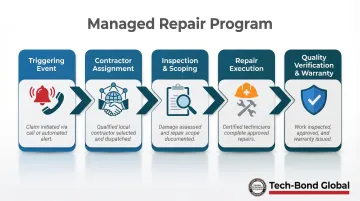
The operational flow follows a structured path from damage report to completed repair:
| Step | Stage | Key Activity | Responsible Party |
|---|---|---|---|
| 1 | Triggering Event | Damage reported; insurance claim or work order filed | End user / property manager |
| 2 | Contractor Assignment | Network matches pre-qualified contractor by geography, specialty, and availability | Network administrator |
| 3 | Inspection & Scoping | On-site damage assessment; scope and cost estimate produced and approved | Assigned contractor |
| 4 | Repair Execution | Authorized repairs performed with approved materials; progress updates provided | Contractor |
| 5 | Quality Verification & Warranty | Quality review conducted; workmanship warranty issued (commonly 1-5 years) | Network quality team |
Key Benefits for Every Party Involved
Benefits for Property Owners and End Users
Managed repair programs eliminate the burden of contractor research during a stressful time and provide:
- Access to pre-vetted professionals who have already passed background, licensing, and insurance checks
- Warranty protection on completed work—typically 1–5 years beyond standard practice
- Faster repair timelines for higher-severity claims
- No hidden out-of-pocket costs—policyholders pay only their deductible, regardless of whether they use the managed network
Benefits for Insurance Carriers and Facility Operators
Organizing entities gain:
- Cost predictability through pre-negotiated pricing structures
- Fraud and overcharge prevention — smarter review models reduce inflated bills by 20% to 27% on commercial claims
- Reduced claim disputes due to clear scope and pricing agreements
- Consistent quality outcomes that protect their reputation and reduce rework
Benefits for Contractors
Joining a managed repair network provides contractors with:
- A reliable pipeline of qualified work without extensive independent marketing
- Lower customer acquisition costs, since the network handles lead generation
- Credibility through association with a vetted network, which encourages higher performance standards
- Clear performance expectations and simplified billing processes
Balanced View—Considerations and Criticisms
Managed repair programs are not without controversy. Public adjuster associations, including the FAPIA concerns, have raised concerns about potential conflicts of interest when the organizing entity controls both claim payment and repair execution.
That said, end users typically retain the right to approve all work and can opt out and hire their own contractor—though coverage caps may apply. For instance, Coverage cap for opting out.
How Contractors Get Vetted and Certified for the Network
Typical Qualification Criteria
Managed repair networks require strict credentialing before admitting a contractor:
- Active licensing and insurance: minimum $1,000,000 General Liability (Each Occurrence), $1,000,000 Automobile Liability, and proof of Worker's Compensation
- At least one year of financial statements or a passing credit rating review demonstrating trade experience
- Criminal background checks on all employees who will be present on job sites
- Verified expertise in specific repair categories the network covers — water mitigation, roofing, pipeline repair, and structural restoration are common examples
Ongoing Performance Matters
Most networks track contractor performance metrics such as:
- Customer satisfaction scores covering timeliness, professionalism, and repair quality
- Claim dispute rates and re-work frequency as indicators of quality control
- On-time completion rates: Contractor Connection, for instance, measures mitigation assignments accepted within 15 minutes and emergency crews on-site within 4 hours
- Technical accuracy, with 100% of line items subject to scope and quantity audits
Contractors who fall below minimum thresholds are removed from the network.
Specialty Certification Strengthens Eligibility
Beyond baseline licensing, specialty certifications signal the verified technical depth that network administrators actively look for. Tech-Bond Global's four-tier certification system, validated through IIT Dhanbad, follows a structured progression: Basic Application, Advanced Pipe & Pressure Repair, Industrial Systems & Safety, and Master Trainer Certification. That kind of independently credentialed expertise is precisely what industrial managed repair programs seek when building networks for pipeline, infrastructure, and polymer repair work.

Common Myths About Managed Repair Programs
Myth 1—"Managed repair programs slow everything down"
Reality: The opposite is typically true. Because contractors and organizing entities share established processes, pricing frameworks, and communication channels, repairs often begin faster than if the end user had to independently research, hire, and manage a contractor from scratch. Industry data shows managed repair programs consistently deliver faster timelines, averaging more than two weeks shorter for higher-severity claims.
Myth 2—"Managed repair programs cost more or reduce the end user's control"
For property insurance claims, the policyholder's only out-of-pocket cost remains their deductible — regardless of whether they use the managed network. End users authorize and approve all work throughout the process. They are not passive bystanders. The program removes the burden of contractor sourcing and verification, not the end user's decision-making authority.
Myth 3—"Contractors in these networks deliver lower-quality work"
Reality: Managed repair networks impose stricter qualification and performance standards than the average independent contractor arrangement. Network contractors are vetted for licensing, insurance, and performance history before they ever reach a job site. That accountability continues after the repair is complete — Contractor Connection warranty.
Managed Repair Contractor Networks in Industrial Infrastructure
Beyond Property Insurance—Industrial Applications
The managed repair contractor network model extends well beyond property insurance into industrial and infrastructure settings. Pipeline operators, municipal water utilities, mining companies, energy facilities, and offshore marine operators maintain pre-approved vendor networks for routine and emergency maintenance.
What Makes Industrial Networks Distinct
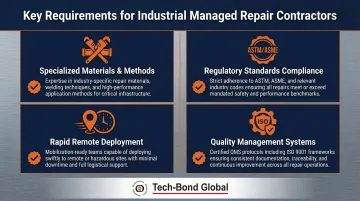
Industrial managed repair networks require contractors to:
- Demonstrate expertise in specialized materials and methods, such as HDPE pipe repair, composite wrapping, or high-pressure piping systems
- Comply with applicable standards including ASTM F2620 standard and ASME PCC-2 for Repair of Pressure Equipment and Piping
- Deploy rapidly to remote or harsh environments where downtime carries significant economic consequences
- Maintain quality management systems aligned with ISO 9001 or API Q2 standards
For example, TC Energy maintains Contractor Quality Requirements requiring suppliers to establish Quality Management Systems and submit approved Inspection and Test Plans.
Field-Deployable, Permanent Repair Technologies
The most effective industrial repair contractors in these networks rely on field-deployable, permanent repair technologies to execute reliable, standards-compliant repairs. Systems like Tech-Bond Global's Tech Patch Repair System (TPRS)—validated for HDPE pipe repair across global deployments—allow contractors to restore pipeline integrity without requiring full replacement or extended system shutdowns. That capability makes them considerably more competitive within managed repair programs focused on minimizing downtime.
That contractor capability feeds directly into a massive infrastructure demand cycle. The U.S. EPA estimates drinking-water systems will require $625 billion for pipe replacement, treatment upgrades, and related assets between 2021–2040—driving demand for durable materials like HDPE and the repair technologies that extend their service life.
Frequently Asked Questions
What is the difference between a managed repair program and hiring your own contractor?
A managed repair program assigns a pre-vetted contractor from the network on your behalf. Hiring independently means you research, select, and manage the contractor relationship yourself. With an MRP, you give up direct contractor selection in exchange for faster dispatch, vetting assurance, and built-in warranty protection.
How do contractors qualify to join a managed repair contractor network?
Contractors must maintain active licensing, appropriate insurance (typically $1M+ General Liability), and demonstrated trade experience. Many networks also require specialty certifications, and networks monitor ongoing performance to maintain active membership.
Can I refuse to use a managed repair contractor network for my insurance claim?
In most property insurance cases, policyholders can opt out and hire their own contractor. However, some policies cap coverage at a lower amount if the insured declines the managed program—always read your policy terms before deciding.
What types of repairs are typically covered under a managed repair contractor network program?
Coverage varies by program. Property insurance networks generally handle water, fire, storm, and structural damage. Industrial networks focus on pipelines, mechanical systems, and infrastructure restoration. Check your specific program for a full scope list.
How does a managed repair contractor network ensure quality workmanship?
Quality is enforced through contractor vetting at entry, performance tracking during membership, mandatory workmanship warranties (often 5 years), and third-party quality review upon job completion.
Are managed repair contractor networks only used in property insurance claims?
No. While the concept is widely associated with homeowner insurance, managed repair networks also operate in industrial, infrastructure, and commercial settings—wherever organizations need consistent, vetted repair work across multiple assets or sites.