

A World in Crisis
There is already a worldwide crisis. Unfortunately, that crisis is going to get worse, especially in the United States. The Crisis has to do with our aging infrastructure. In this case, we are not talking about roads and bridges, we are talking about pipes.
Currently, about 90% of all pipe laid in major infrastructures is HDPE pipe. In the past, it was primarily steel pipe. That steel pipe is getting old and needs to be replaced. Our crisis is that, with price/costs leverls where they are, we can’t afford to replace the pipe.
The Global Cost of Pipe Failure and Replacement
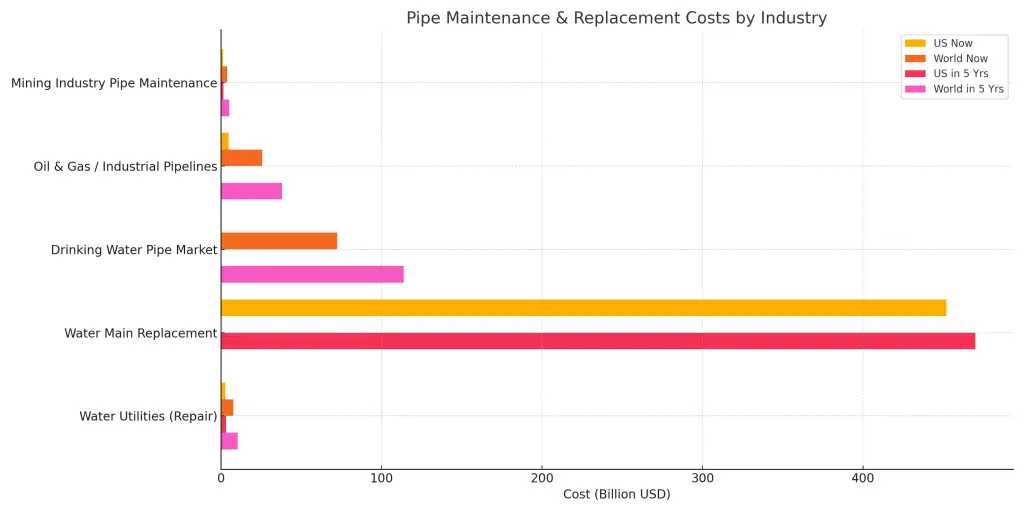
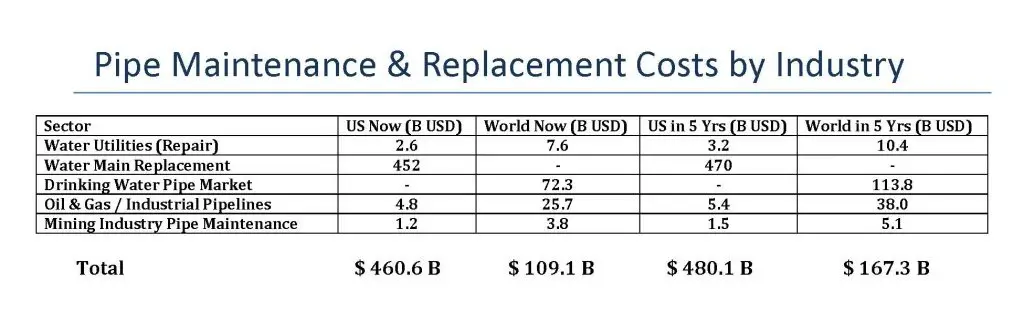
The chart and graph below shows the estimated economic impact of pipe maintenance and replacement across key industries, now and over the next five years.
Why Pipe Infrastructure Costs Matter to the Global Economy
Pipe maintenance and replacement costs—already totaling hundreds of billions annually—are a silent economic pressure affecting every sector from water to energy to mining.
1. Aging Infrastructure = Drag on Growth
As pipes degrade, leaks, bursts, and inefficiencies lead to lost resources, production slowdowns, and emergency repairs. This diverts capital from innovation and expansion into simply staying operational.
2. Compounding Economic Risk
In the water sector alone, failures can:
Disrupt agriculture and industry
Drive up utility rates
Threaten public health
In oil, gas, and mining, poorly maintained pipelines increase environmental risk and regulatory costs, damaging public trust and company valuations.
3. Barrier to Development
For emerging economies, outdated or limited pipe infrastructure limits growth. Reliable pipelines are essential to support:
Urbanization
Manufacturing
Clean energy transitions
4. Massive Opportunity
These costs also represent a multi-trillion-dollar opportunity for innovation:
Durable repair systems like TPRS reduce lifecycle costs
Smart sensors and AI-enabled maintenance can predict failures
Advanced bonding and material technologies extend asset life
Summary:
Pipe-related costs are not just engineering concerns, they are economic levers that need to be used. Reducing these costs will create ripple effects across GDP, environmental policy, and global competitiveness.
But HDPE pipe cannot be repaired!
That was then, this is now!
Lorem ipsum dolor sit amet, consectetur adipiscing elit. Ut elit tellus, luctus nec ullamcorper mattis, pulvinar dapibus leo.