
Practical Definition.
The Polymer Bonding Process changes the surface so it will join.
On plastics, it causes polymerization.
On metal, wood, ceramic, or rubber, it makes molecular bonds.
Either way, the goal is the same: a bond between the substrates.
We cross-link the prepared surfaces with a catalyst and gentle heat.
This makes an exothermic reaction that ties the two sides together.
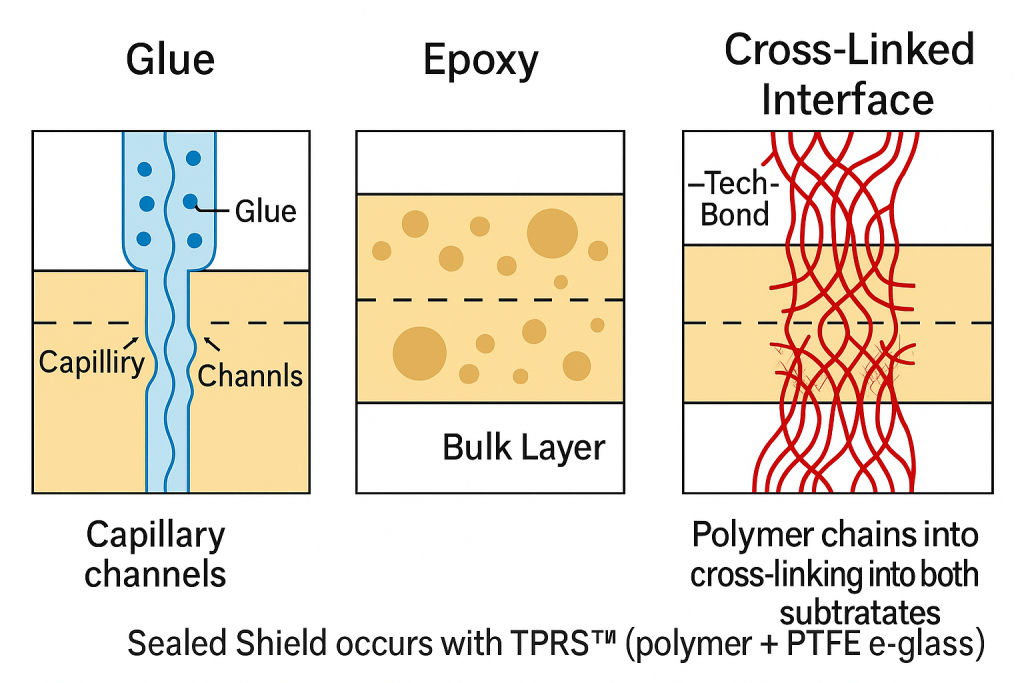
Our Bonding Agents do not sit on top like glue.
They are not a thick epoxy layer either.
The Process fuses the actual materials at the interface.
Result: a permanent join that can flex if the base material flexes, and a non-wicking interface that blocks moisture paths.
The Polymer Bonding Process
Advantages of a Bond over a Glue Join
For the Geeks,
Bonds formed by interfacial polymerization and cross-linking between substrates create a contiguous molecular network that transfers load directly through the interface, maintaining integrity under shear, peel, vibration, and thermal cycling. In contrast, glue joins rely on a discrete adhesive layer and weak secondary forces, leaving capillary pathways and interfacial defects that promote moisture ingress, creep, and premature failure.
For the non-Geeks
A bond turns the two surfaces into one piece—like stitching two fabrics together—so it carries and spreads load smoothly, flexes with movement, and doesn’t leave gaps for water to creep in. A glue join is more like tape between the pieces; it can peel or crack under stress, and these tiny gaps let moisture into the glue join. Often, moisture is the start of bond failure.
Summary
Adhesives and epoxies leave a separate layer between parts—a “glue line.” That layer can be a weak plane: it can creep, crack, or form tiny capillary paths that let moisture in, and it often has different stiffness and thermal expansion than the parts, which adds stress. Tech-Bond’s bonding creates a cross-linked interface between the substrates (often with no measurable adhesive layer), so load transfers through the joined materials themselves. The result is a stronger, more durable, non-wicking join that tolerates vibration, pressure, and temperature swings far better than a conventional glue line.