
The Technology Behind Tech-Bond’s Permanent Repair & Restoration Platform
Tech-Bond’s Permanent Repair and Restoration Platform is built on Molecular Integration—a breakthrough approach to bonding and repair that replaces weak, layered systems with a unified structure. Where legacy methods rely on interface layers that can separate over time, Molecular Integration forms a stable, permanent bond that resists moisture intrusion, thermal cycling, creep, and delamination.Legacy Adhesive Systems.
The Polymer Bonding Process
In the Polymer World, every major advancement. all the way back to Charles Goodyear, has been empiricaL, i.e., trial and error. For Mr. Goodyear, developing the formula for tires took years. Likewise, developing the Polymer Bonding Process also took years. Sixteen years of working with companies on their need to bond polymers.
During these early years, Tech-Bond had a way to bond thermoplastics reliably, but the same chemistry did not work on thermosets or elastomers, the other two classifications of polymers. Then one day I added physics, physics in the form of heat, i.e; warming, to the established chemistry of bonding thermoplastics and the result was the Polymer Bonding Process (Process). With the Process, anyone, anywhere can bond any polymer to itself, to any other polymer and to almost any other substrate.
The Process: Foundation of a New Materials Science Platform
The Process is the foundation of a new materials science platform — the Tech-Bond Permanent Repair and Restoration Platform (the Platform).
Historically, meaningful advances in polymer science have occurred inside laboratories and controlled manufacturing environments. From Charles Goodyear’s vulcanization breakthrough to modern composite engineering, polymer innovation has depended on factory-controlled heat, pressure, and curing systems.
Field environments were never part of that equation.
Until now.
The Platform changes where polymer science can operate. What it enables is the bonding of polymers — including low surface energy materials — directly in the field. In mines. On farms. On offshore platforms. Inside municipal infrastructure. In remote industrial sites. Anywhere.
For the first time, high-performance polymer bonding is no longer confined to a lab or factory floor. It can be deployed where failure actually happens.
That is a fundamental shift in materials application.
The Tech-Patch Repair System (TPRS™)
The Process is the enabling technology behind the Tech-Patch Repair System (TPRS™) — a field-deployable system that permanently repairs pipes and tanks on-site, anywhere in the world.
TPRS™ allows infrastructure owners to restore HDPE, steel, PVC, cast iron, and other substrates without replacement. Instead of cutting out sections, welding, or shutting down operations for extended periods, repairs can be performed in place — with permanence engineered into the bond.
With aging pipelines, expanding municipal systems, and rising material and labor costs, replacement is becoming increasingly expensive and disruptive. TPRS™ offers a structurally stable, long-life alternative that can prevent catastrophic failure, reduce downtime, and avoid unnecessary capital expenditure.
As global infrastructure ages and replacement costs continue to escalate, the economic implications are enormous. The Platform does not simply repair leaks — it extends asset life. At scale, that translates into billions in avoided replacement costs for companies, utilities, and municipalities worldwide.
Legacy Adhesives — How They “Stick”
Traditional epoxies and glues bond primarily through mechanical adhesion. They rely on surface roughness to create grip. When a surface is sanded or blasted, it develops tiny grooves, pores, and micro-crevices. Adhesive flows into these irregularities and hardens, forming a mechanical lock. In simple terms: the adhesive “fills in the black spaces. The rougher the surface, the more microscopic niches exist for the adhesive to anchor into. This is why aggressive abrasion often improves bond strength in traditional adhesive systems. But this mechanism has both a positive and a negative side.
Positive Impact
With legacy adhesives, increased surface roughness generally increases initial bond strength. More crevices mean more mechanical interlock, and more interlock typically means better short-term performance.
Negative Impact
Those same micro-crevices that improve initial grip also create microscopic pathways. Over time, these pathways allow:
- Moisture intrusion
- Vapor penetration
- Fuel migration
- Creep under sustained load
As moisture or contaminants work into the interface, stress concentrates at the bond line. Thermal expansion and contraction amplify this effect. Gradually, microscopic separation begins. That separation spreads. Eventually, the adhesive joint fails — often long after the repair “looked solid.”
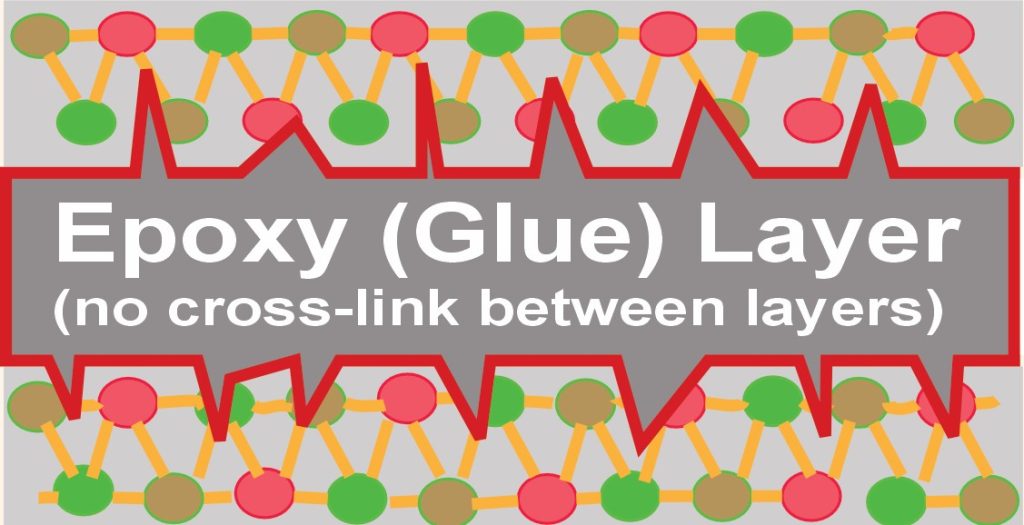
In layered systems, every interface is a potential failure plane. An illustration of an epoxy bases layered system is below.
Molecular Integraton
How Molecular Integration Is Different
Molecular Integration does not depend solely on mechanical interlock. While proper surface preparation remains essential, the objective is not simply to “fill in black spaces.” The goal is to create a stable, unified architecture at the interface — one that resists intrusion rather than inviting it.
Traditional adhesives form a hardened layer that sits between two materials. Even when strongly bonded, that layer remains a distinct boundary. Under stress, moisture, fuel exposure, vibration, and thermal cycling, that boundary becomes the weakest link.Molecular Integration approaches the interface differently.
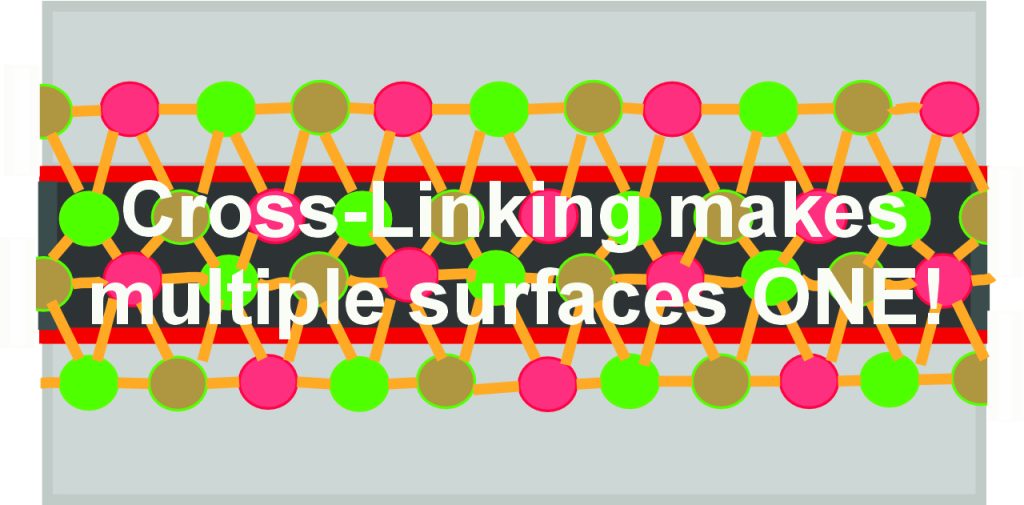
Molecualr Integration approaches the interface(s) differently
Instead of creating stacked layers, the Process is designed to form a continuous cross-linked structure that stabilizes the interface and minimizes pathways for moisture migration, creep, and delamination. The bond is engineered to behave with the substrate — expanding and contracting under temperature changes, tolerating vibration, and maintaining integrity under long-term load.
The result is not simply higher initial bond strength.
The result is long-term structural stability.
Where legacy adhesives rely on roughness to hold on, Molecular Integration is designed to eliminate the very failure planes that cause traditional systems to break down over time.
This is why the Platform performs in environments where layered adhesive systems eventually fail.
Platform Capability #1
Bonding Low-Surface-Energy Polymers
Low surface energy materials (like PTFE, HDPE, and polypropylene) resist bonding because adhesives cannot properly wet and grip their surfaces. That’s why many traditional adhesives fail—especially when exposed to heat, vibration, moisture, or fuels.
Molecular Integration changes what’s possible by enabling reliable bonding to materials that have historically been considered “unbondable” or “difficult-to-bond.”
Common materials Tech-Bond can address
- PTFE (including virgin PTFE)
- HDPE
- Silicone rubber
- Nylon (polyamide)
- Other polymers and mixed-material assemblies
Explore Polymer Bonding Applications
(PTFE bonding, HDPE bonding, silicone bonding, nylon bonding)
Platform Capability #2
Permanent Repair and Restoration for Pipes & Tanks
When infrastructure fails, replacement is expensive—often dramatically more expensive than repair once labor, downtime, and logistics are included. Tech-Bond’s Platform supports permanent restoration of common pipe and tank substrates, including the materials that legacy systems struggle with most.
The flagship product of the Platform: TPRS™
TPRS™ (Tech Patch Repair System) permanently seals cracks and holes in HDPE, steel, PVC, cast iron, and concrete pipes and tanks. The system creates a unified cross-linked structure that is moisture, fuel, and vapor proof — delivering a repair that is guaranteed for the life of the pipe.
The result: bonds are moisture, fuel, and vapor proof and are unaffected by thermal cycling, and the permanence is guaranteed for the life of the pipe.
Fix a Leak with TPRS™
(HDPE pipe, steel pipe, tanks, PVC, cast iron, concrete)
What Makes the Platform Different
1) Interface Layer Elimination
Instead of relying on multiple boundary layers that can separate over time, the Platform creates a unified structure designed to remain intact under real-world service conditions.
2) Designed for Low-Energy Surfaces
Many systems perform well on metals and fail on polymers. Tech-Bond was built specifically to solve polymer bonding—including the hardest materials in the world to bond.
3) Thermal Conformance
Thermal Conformance refers to the bond’s ability to expand and contract with temperature changes—where other technologies crack or separate. This is crucial for outdoor equipment, pipelines, tanks, and any system exposed to thermal cycling.
4) Permanence Under Harsh Conditions
Industrial environments expose repairs to moisture, fuels, UV, vibration, pressure swings, abrasion, and temperature extremes. The Platform is built to withstand these realities—not lab-only conditions.
5) Field-Proven Performance
Tech-Bond’s Platform is backed by years of continuous field success and ongoing verification/testing through institutional collaboration.
Where the Platform Is or Can Be Used
Tech-Bond’s Permanent Repair & Restoration Platform is deployed across industries where failure is expensive:
- Oil & Gas – pipelines, tanks, corrosion service restoration
- Mining – downtime avoidance, harsh environment repairs, HDPE and steel infrastructure
- Water & Wastewater – leak elimination, long-life infrastructure repair
- Energy & Industrial Manufacturing – equipment repairs and polymer bonding
- Specialty Polymer Applications – PTFE and other low-energy materials
Frequently Asked Questions
Is this just an adhesive?
No. The Platform is designed to replace layered repair architectures with a unified structure that resists moisture intrusion, thermal cycling, creep, and delamination.
Does it work on HDPE?
Yes—HDPE is one of the primary substrates the Platform was built to address, including permanent repairs using TPRS™.
Can you bond virgin PTFE?
Yes. Virgin PTFE (unetched) bonding is one of the key differentiators of the Platform.
Is it temporary or permanent?
The Platform is engineered for permanent performance. TPRS™ repairs are positioned as guaranteed for the life of the pipe when installed correctly.
Start Here
Choose the path that matches your problem:
🔬 I need to bond a difficult polymer
PTFE • HDPE • Silicone • Nylon
Go to Polymer Bonding
🔧 I need to permanently repair a leak
Pipes • Tanks • Cracks • Holes
Go to TPRS™ Repairs
Talk to a Technical Specialist
If you’re evaluating a specific substrate, environment, or failure mode, Tech-Bond can recommend the right pathway and application approach.
▶ Contact Tech-Bond
▶ Request a Technical Call
▶ Shop Repair Kits