
Industrial Packs | Your company can save 60 – 70% or more on pipe maintainance. Both the technology, our patented Polymer Process (the Process), and the product, the Tech Patch Repair System (TPRS) have been proven in the lab and in the field.
No Time to Waste
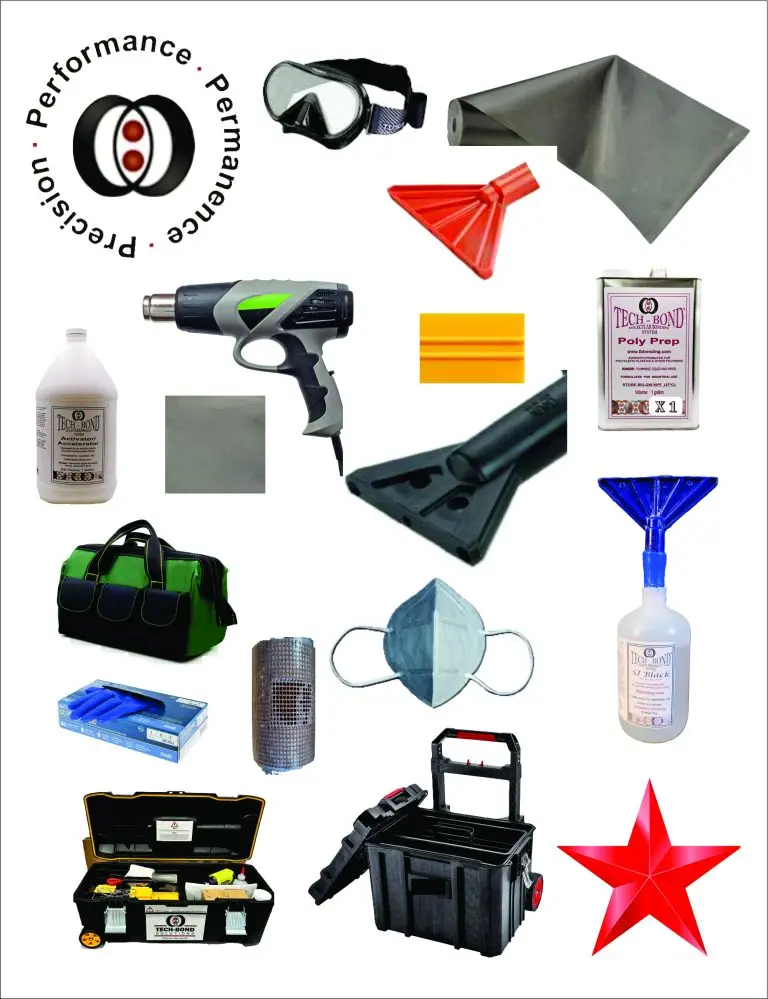
Industrial Packs include everything needed to apply a Tech Patch or Tech Wrap in any environment. While proper ventilation is always recommended, certain situations make that impossible. That’s why each Pack comes equipped with protective masks and goggles to ensure safety under all conditions.
Each Industrial Pack also contains every essential application tool—gloves, spreaders, applicators, shop towels, a heat gun, and a rotary sander—organized inside a durable, portable container.
So, no matter the pipe type or the extent of the damage, technicians can simply grab the Pack and get the job done quickly and correctly.
In addition, industry-specific Packs are now being developed. Each sector—whether mining, water management, automotive, or industrial maintenance—will soon have a range of Pack sizes designed for its unique needs.
Ultimately, downtime costs accumulate by the minute. Having an Industrial Pack on-site, ready to handle any situation, dramatically reduces those costs while keeping operations running smoothly.
We have learned from experience that applying a Tech Wrap is not something that can be done by the novice. In all the training sessions that we have conducted, with both experienced trades people and individuals from the street, there has only been one individual who did not have a problem. Then there are the “situations” that are encountered underneath a vehicle, such as:
Ridges in the tank.
Phlange close to the hole or crack.
Gas tank too close to the exhaust system.
A Double Curve
There are just a few of the examples that can arise with a damaged gas tank. Our training presents “Best Practices” for handling these issues and more. Click on the link below to learn about our training programs.
After nine years of experience in presenting the Polymer Bonding Process and the Tech Patch Repair System, we understand the disbelief that exists about bonding polymers (PTFE, silicone rubber, HDPE, nylon, etc.), repairing poly tanks (water tanks, fertilizer tanks, holding tanks, overflow tanks, etc.), and gas tanks, whether plastic or metal. Below is a link that will take you to our Amazon review on our patches that repair gas tanks. Our Amazone rating is 4.6, but your really need to read these reviews to have “the Whole Story”.
Mini-Packs
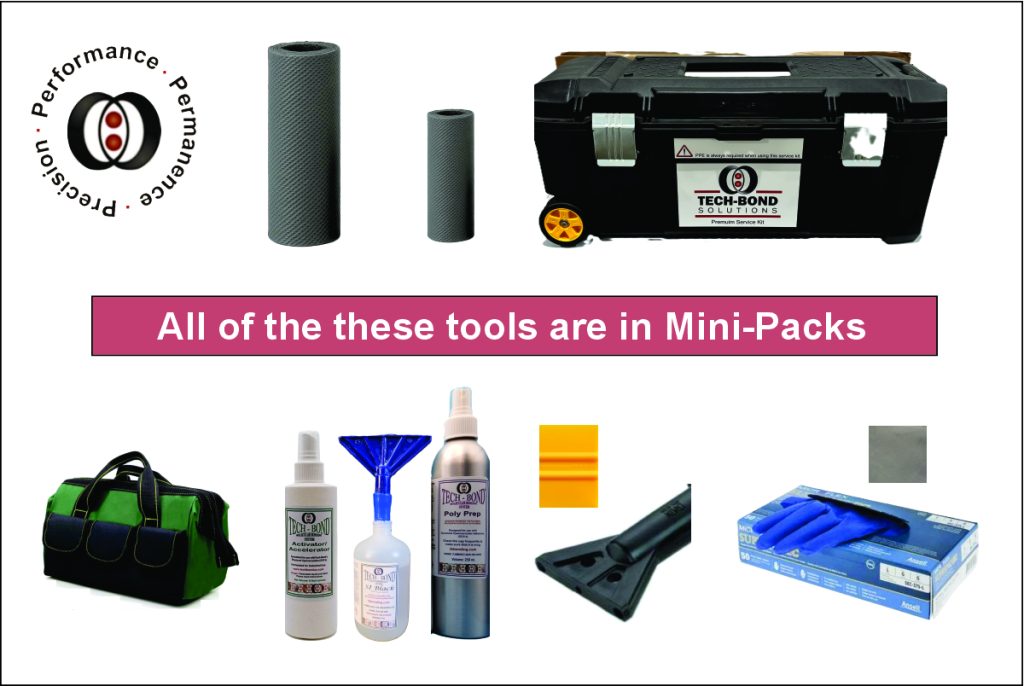
Mini-Packs are Revenue Generators
When you assume a 12-inch-square patch—cut to fit—the average cost of goods sold (COGS) for a single TPRS™ repair ranges between $11.00 and $13.00. If the average service charge is $150, the profit margin reaches an impressive 91–93.5%. In contrast, the fee to replace a damaged tank often exceeds $500, and in many cases, a replacement tank isn’t even available in today’s constrained market.
When a gas tank fails, for example, the owner doesn’t want to wait—they want it fixed immediately. Downtime costs money. That same principle applies across every industry that relies on tanks, from agriculture and mining to automotive and manufacturing.
As soon as the market realizes there is a proven, permanent solution for poly tank repairs, the demand for TPRS™ will surge. The reason is simple and universal:
Replacement cost is high, and
Replacement tanks are often unavailable.
The supporting data and graphics come directly from AI-driven market modeling—and they do not include Canada. When Canada is factored in, the combined poly tank market likely exceeds one trillion dollars.
Number of damaged poly tanks needing repair annually.
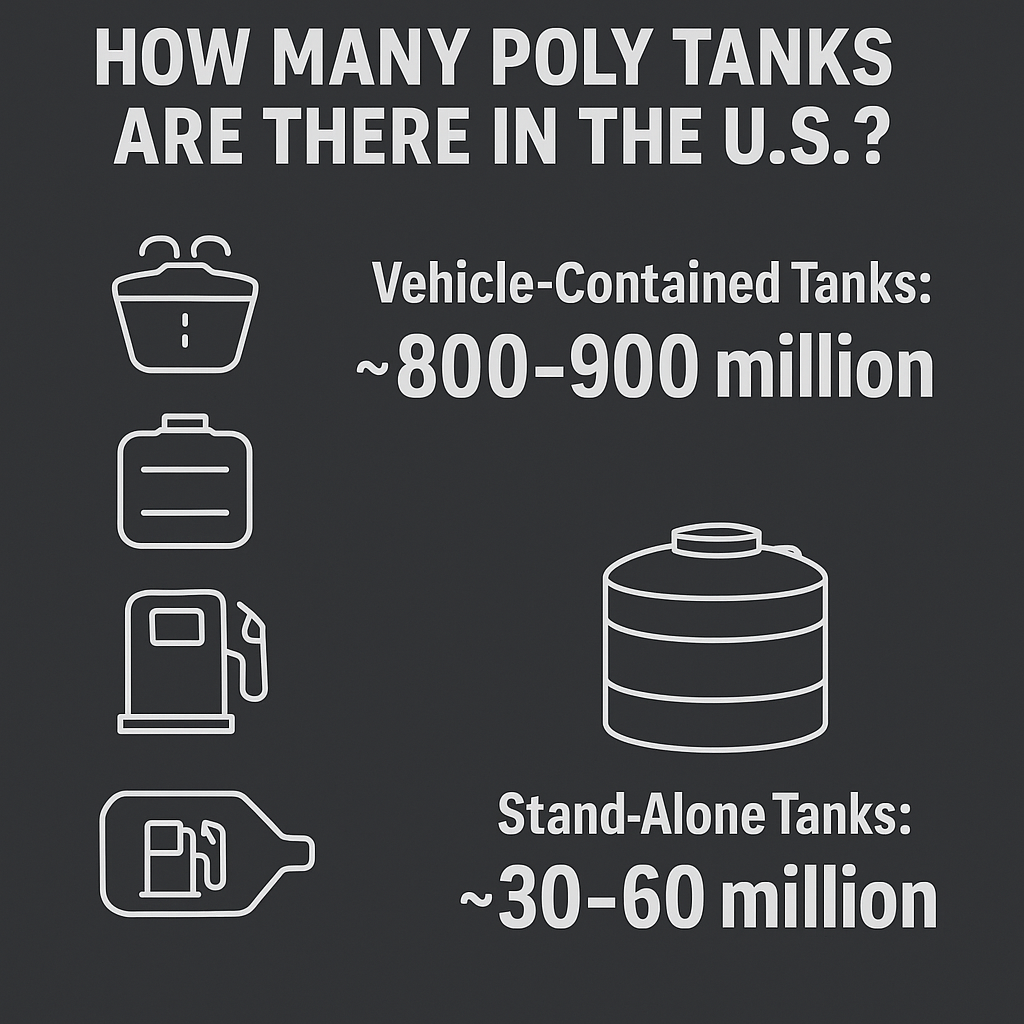
AI now estimates that 1.3–1.5% of all poly tanks in the U.S. require repair every year. That translates to more than one billion tanks needing attention. If we assume that half of those are actually repairable, we’re looking at 500 million tanks ready for repair rather than replacement.
AI further projects that replacement costs—materials plus labor—average between $450 and $1,200 per tank. Using 60% of the upper range, or $720 per tank, the total annual replacement cost climbs to $432 billion.
Now, here’s where it gets powerful: TPRS™ can conservatively save 75% of that cost. In other words, $324 billion could stay in the hands of consumers and corporations alike. At a time when budgets are tight and cost control drives every decision, that number matters. For perspective, no company on earth earns $324 billion in profit per year—not even Saudi Aramco, Apple, or Microsoft.
And the projection doesn’t even include large tanks above 5,000 gallons. TPRS™ has already repaired tanks up to 10,000 gallons—easily. Under ISO 1167 and 13479 testing, which pushes systems to failure, Tech Patches applied to HDPE did not fail even after surviving 1,800 psi for more than 100 hours.
Final Numbers
Take a long look at those numbers. No HDPE tank or pipe comes close to having a rating of 1800 psi. Actually, in the test, the patch did not fail, the HDPE pipe blew out. That translates to performance … and permanence
At this point of time, Tech-Bond is the only game in town. No other company can bond polymers. No other technology can repair a poly tank with any degree of durability. The competition can not repair HDPE pipe. No other company in the world can repair HDPE pipe, or has a patch that can be applied to steel pipe that is impervious to moisture.
As you peruse the techbondglobal website, you will learn that bonds created through the Polymer Bonding Process are permanent. That our Tech Patch and Tech Wraps are easily applied and the results are permanent. You will learn that the materials used in TPRS are superior to the materials used by composite wraps, our competition. It should not come as a surprise that end users love the Process and TPRS. Manufacturers not so much. What does all that mean? Simply put, the world needs TPRS.