
HDPE Gas Tank Repair, Poly Gas Tank Repair, Plastic Gas Tank Repair (Terms are interchangeable)
The important thing to understand before you start is that HDPE Gas Tanks, and any poly or plastic gas tank, is one of the most difficult things in the world to eally repair. Two reasons. First, HDPE tanks, all poly tanks, are “low energy” surfaces. Secondly, gasoline, with its low viscosity and low surface energy, will find a way out … if a way out exists. Plus, low viscosity gasoline fumes will penetrate even hairline cracks. Then, when there the temperature increases, those fumes will xpand the crack(s) to generate a real leak. If these cracks are not fixed, the tank will continue to deteriorate. The higher the octane, or the more additives in the gasoline mixture, the faster the cracks grow.

So, for a complete repair of a gas tank, you have to take care of the issues of low surface energy, low viscosity, high octane levels and possible additives in the fuel mixture. We are going to explain how each step in the our HDPE tank repair process mitigatesPlastic Gas-Tank Repair
In almost all cases, we recommend a patch-on-a-patch solution for the repair of a gas tank. A single layer of patch will be effective for repairing hair line cracks and holes less than a half inch in diameter. Patches must extend 1 inch beyond the damage on all sides.
When Is a Patch-on-a-Patch Repair Necessary for an HDPE Tank?With ol
Tech-Bond’s Patch-on-a-Patch Repair System provides an additional level of reinforcement and protection when repairing HDPE tanks exposed to demanding conditions. This approach is particularly recommended for gas tanks containing premium or high-octane fuels, larger holes or cracks, deteriorated or weakened plastic, and areas subject to repeated flexing, vibration, or stress. The first patch seals the damaged area and establishes a strong bond with the tank’s surface. The second, larger patch overlaps the first, extending onto the surrounding tank material to distribute stress over a wider area and provide an additional protective barrier. For older tanks where the plastic has become brittle or degraded, this added reinforcement can be especially valuable, provided the surrounding material remains structurally sound. The result is a stronger, more durable repair designed to withstand demanding service conditions.
With older tanks or if you use high test gas or use fuel additives, the patch-on-a-patch solution is recommended.
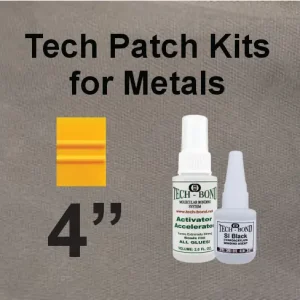
Choose the widths and lengths of your primary and secondary patches below. If you need custom patches for your tank, please call 877 676 7225.